New Year Traditions Explained: Midnight Celebrations, Good-Luck Foods, and Fresh Starts

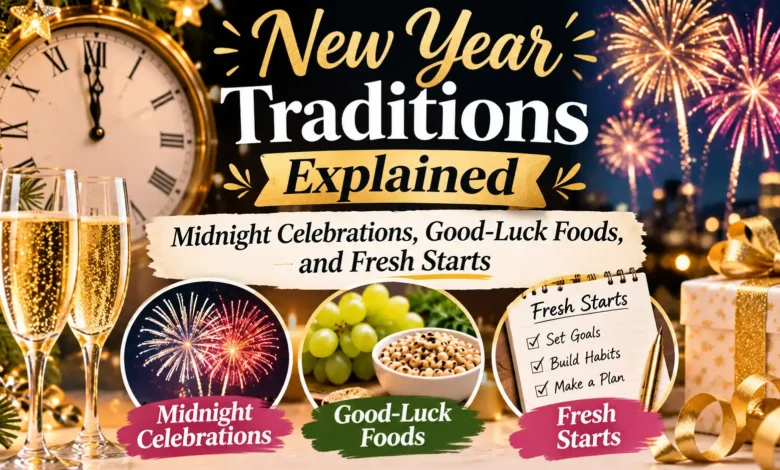
New Year traditions give the change of date something you can hear, taste, or do: a midnight countdown, a meal associated with good fortune, or a decision about what comes next. The celebration marks the moment, the food carries a wish, and the fresh start turns that wish into a personal intention.

The visuals are AI-generated concepts that illustrate the traditions and serving ideas. They are not photographs of documented celebrations or kitchen-tested recipes.
If you want to bring a tradition home, choose one that fits your evening. Join a countdown if you enjoy a shared celebration, serve a meaningful dish if you would rather gather around the table, or leave a little time on January 1 to reflect. You do not need to combine every custom into one night.
The examples below focus on the December 31–January 1 New Year. Other calendars have their own New Year celebrations, and customs vary among families within the same country. Good-luck beliefs describe hopes and symbolism; they cannot predict what your year will bring.
Why midnight celebrations mark the turning point
For the January 1 calendar New Year, midnight is the boundary between the last day of one year and the first day of the next. Counting down makes that otherwise invisible change a moment everyone in the room can recognize together.

In the United States, the Times Square ball drop gives that countdown a familiar visual. According to the Times Square Alliance, the first ball descended on December 31, 1907, welcoming 1908. The event became a tradition of its own; it did not create the idea of celebrating New Year.
A toast, a cheer, or a hug gives you a way to greet the people beside you at the turn of the year. A midnight kiss can be part of that greeting if both people want it, but there is no relationship test hidden in the countdown. A wave across the room or a call to someone far away can carry the same good wishes.
Why “Auld Lang Syne” belongs in the moment
The song looks backward while the calendar moves forward. Its Scots title roughly means “for old times’ sake,” and its words center on remembering old friendships. Robert Burns recorded and contributed to the song in the late 1780s. That connection to memory helps explain why it fits a gathering where people are saying goodbye to a year together.
Make your countdown easy to share
Pick one clock or broadcast for the room so everyone follows the same cue. If you are watching a New York celebration from another U.S. time zone, decide whether you are joining Eastern Time or waiting for your own local midnight. Set out drinks before the final minute so nobody spends the countdown looking for a glass; sparkling water or juice works for a toast, too.
For food you can serve before the countdown, browse 21 Easy New Year’s Eve Appetizers, From Warm Dips to Bite-Size Snacks and choose a few dishes that suit your gathering.
Why Spain welcomes the year with twelve grapes
Spain’s twelve-grape custom connects a small food ritual to the striking of midnight. The traditional pattern is one grape for each of the twelve midnight chimes, with the grapes associated with good fortune for the coming year. Madrid’s Puerta del Sol is a well-known gathering place for the celebration, while many families follow the clock broadcast from home.
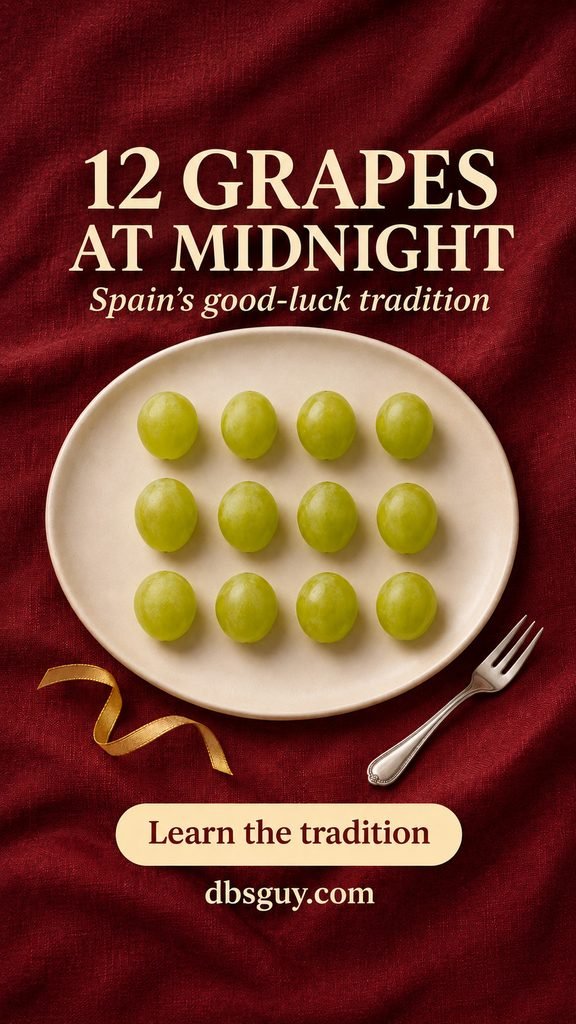
The number matters because this is a twelve-chime ritual. It is different from a spoken countdown from ten, so a typical party countdown will not provide twelve evenly spaced cues. You can explain that distinction before guests try to follow along.
For an adult table, counting twelve washed grapes into a small dish for each person makes the meaning visible before the clock begins. Explain where the custom comes from, and let guests decide whether to take part. You can also enjoy the grapes slowly after midnight as a relaxed adaptation of the timed custom.
Keep eating separate from a race. Whole grapes are a choking hazard for young children. The CDC advises preparing food for a child’s development, keeping them seated and supervised, and avoiding rushed eating. Let young children join the countdown without the timed grape-eating; any grapes served separately need to be cut into appropriate small pieces.
If you miss a chime or leave grapes in the dish, you have not learned anything about the luck ahead. The useful part is the shared wish. Eating under a table or adding a particular wish for romance is not necessary to take part in the twelve-grape custom described by Spain’s official tourism guidance.
What black-eyed peas, greens, and cornbread symbolize
A Southern New Year’s Day meal often brings together black-eyed peas, cooked greens, and cornbread. The familiar symbolism links the peas with coins or luck, the greens with paper money, and golden cornbread with gold. Together, they turn an ordinary plate of food into a wish for enough in the year ahead.

These foods also belong to living family traditions. Black American foodways are an important part of the story. Writing for the Smithsonian Center for Folklife and Cultural Heritage, foodways coordinator Lirit Gilmore describes her family’s January 1 meal of greens for wealth and black-eyed peas for luck, and notes that many Black Americans share a New Year beans-and-greens tradition.
That context matters more than treating the meal as a universal rule for every Southern household. Families choose different greens, seasonings, and accompaniments. If someone is sharing their own family version with you, ask what the meal means to them.
Where Hoppin’ John fits
Hoppin’ John pairs peas and rice; black-eyed peas are common in modern versions, and many preparations include pork. It can be the center of the New Year’s meal, with greens and cornbread alongside. A plate of separately cooked black-eyed peas and rice can be an easy serving choice, but Hoppin’ John also has particular regional and family preparations worth learning.
For a manageable January 1 lunch, choose a reliable peas or Hoppin’ John recipe, one cooked green, and cornbread. If your guests do not eat pork, use a meat-free preparation and check the broth and greens seasonings as well. You do not need to put meat in the meal to share a wish for prosperity.
Serve the meal when your household can sit down and enjoy it. The symbolism gives lunch a story; it does not require you to stay awake cooking after a late night.
Why lentils appear on an Italian New Year table
In Italian New Year traditions, lentils are associated with prosperity and good fortune. They are often served with cotechino, a rich pork sausage, or zampone, a stuffed pig’s trotter. Italia.it, Italy’s official tourism website, describes the pairing as a festive classic and notes that families differ in when they serve the lentils: some bring them out at midnight, while others have them as a side dish.

This helps answer a common hosting question: the meaning is tied to the food and the occasion, while the serving time can follow the household’s custom. If you are celebrating with an Italian family, follow their lead rather than assuming there is one exact schedule.
For your own dinner, decide whether you want to explore the traditional pairing or make a lentil dish that suits your guests. A meat-free lentil side is an adaptation you can name plainly. It lets you introduce the prosperity symbolism without suggesting that your version represents every Italian New Year table.
If you buy cotechino, check whether the package contains a raw or precooked product and follow its directions. That choice changes the preparation needed; a serving photograph cannot tell you how your particular product should be cooked.
There is no need to add the Southern peas-and-greens meal to the same dinner. Choose the tradition you are interested in learning about, explain it briefly, and give the dish room to be enjoyed.
How a fresh start becomes something you can actually do
The New Year gives you a clear point from which to look back and choose a direction. Research calls the motivational pull of meaningful beginnings the “fresh start effect.” In a 2014 study by Hengchen Dai, Katherine Milkman, and Jason Riis, measures of goal pursuit increased after time landmarks such as the start of a week, month, or year.

The study supports the idea that a new beginning can encourage starting. It does not mean a January resolution will automatically become a lasting habit. Use the date as a prompt, then decide what you will do after the holiday feeling passes.
Try three short reflection prompts
Take a sheet of paper and write these headings. Keep each answer short enough that you can return to it next week.
- Keep: What helped you this year? Name one specific routine, relationship, or activity you want to make room for again.
- Change: What recurring problem would you like to handle differently? Choose something you can influence rather than a result that depends entirely on someone else.
- First step: What action will you take, and when? “Read two pages after I put my phone on charge on Monday” is easier to act on than “become a reader.”
These prompts are a practical suggestion, not a tested program. Their purpose is to turn a broad wish into a decision you can recognize in an ordinary day. Pick a time to look at the page again, and adjust the action if it does not fit your actual schedule.
You can also use this moment to reconnect. Choose one person you want to thank, then mention a real kindness or shared memory. If you need help finding an opening, the Happy New Year messages for heartfelt greetings and funny texts offer wording you can adapt.
Put together a celebration you would enjoy repeating
A simple plan might be dinner on December 31, one shared countdown, and a quiet reflection over breakfast on January 1. Choose one food tradition if it interests you, or keep a dish your family already loves. An early evening toast can be your own adaptation if midnight does not suit the people celebrating.
Leave room for people who would rather listen than share a resolution aloud. A tradition becomes personal through repetition and meaning; nobody needs to announce a major life change to have a place at the table.
Questions about New Year traditions
Are good-luck foods eaten on New Year’s Eve or New Year’s Day?
It depends on the custom. Spain’s twelve grapes belong to the midnight chimes as December 31 becomes January 1. Southern black-eyed peas and greens are commonly a New Year’s Day meal. Italian lentils may be served during the evening meal, at midnight, or as part of the family’s New Year table.
Do lucky foods really bring money or good fortune?
The claims are folklore and symbolism, not a promise of financial results. You can enjoy the foods as expressions of hope, family connection, or cultural interest without believing that they determine the future.
Can you celebrate without alcohol or staying up until midnight?
Yes. Use a drink you enjoy for a toast, hold an earlier family countdown, or make January 1 lunch your main gathering. Describe an early countdown as your household’s adaptation rather than the actual local start of the year.
Do you have to make a New Year’s resolution?
No. You might prefer to remember a good moment, thank someone, or keep a routine that already helps you. If you do choose a goal, give it a first action and a place in your schedule. You can begin again after January 1, too.