
Start with a work you can name: the artist or maker, the medium, and where it comes from. Then give it a clear place in your room. That approach will take you further than buying a collection of vaguely “African-inspired” accessories.
For a first purchase, consider an authorized print by an Ethiopian artist, a contemporary original, or a documented Ethiopian-made textile. Let that piece lead the colors and textures around it. You can keep your existing sofa, paint, and furniture.

The images in this guide are AI-generated styling concepts. The pictured artwork and textiles are invented illustrations of placement and color, not authenticated Ethiopian works, reproductions by named artists, or products for sale.
Understand what you are bringing home
Ethiopian art is not one visual style. The Walters Art Museum’s Ethiopia at the Crossroads exhibition overview places historic religious objects, basketry, and contemporary works within a much wider cultural history. Christian icons and manuscripts have religious purposes; they are not simply a source of decorative faces and patterns.
Contemporary art gives you another starting point. The Alliance Ethio-Française virtual painting collection introduces individual artists and different approaches to painting. Browse to discover whose work interests you, rather than looking for a single “Ethiopian palette.”
A cream wall, dark wood, or rust cushion can support many artworks. Those decorating choices do not make a room Ethiopian. The connection comes from the actual work, its creator, and the context you preserve.
Buy with the maker and the meaning in view
Before shopping, decide whether you want an original, an editioned print, an open-edition reproduction, or a crafted textile. These are different purchases. A low-priced poster should not be described as an original painting, and “Ethiopian-inspired” does not mean made in Ethiopia.
Look first at an artist’s own sales channel or a gallery that identifies the creator. Addis Fine Art is an Addis Ababa-based contemporary gallery and a useful place to begin learning about represented artists. Ask about current availability and shipping rather than assuming every exhibited work is for sale.
For textiles, look for a named design studio and clear production information. For example, Bolé Road’s Kombolcha pillow description identifies Ethiopian handwoven cotton and explains its reference to Wollo gabi patterns. That level of specificity is more useful than a generic heritage label. Follow the instructions for the particular textile you buy.
Questions worth asking before you pay
- Who made or designed this piece, and what is its title?
- Where was it made? Does the seller distinguish the designer from the workshop or weavers?
- For a print, is the reproduction authorized? What are the paper, image size, and edition details?
- For an older object, what ownership history and lawful sale or export documentation are available?
- Does the subject, writing, or object have a religious or ceremonial use?
- What are the delivered cost, return terms, framing needs, and care instructions?
Keep the invoice and the maker’s description together. If the seller cannot explain an object’s origin or meaning, pause the purchase. For a first home project, a clearly documented contemporary work usually gives you a simpler path than an unidentified antique.
Three ways to style the piece you choose
These are decorating approaches, not rules about Ethiopian culture. Choose the one that fits your space and the work itself.
1. Give a contemporary artwork one strong focal wall
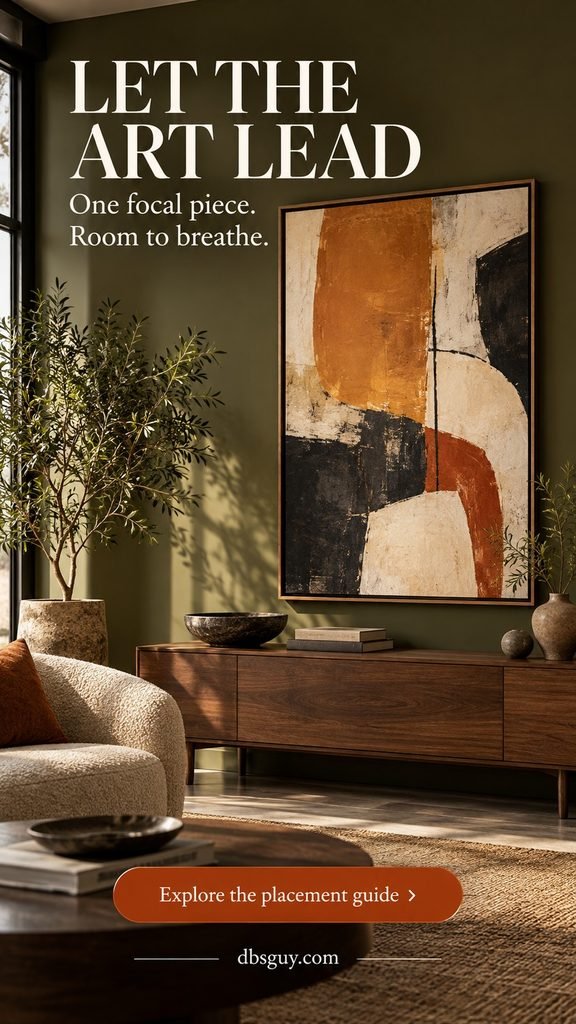
A single substantial work can anchor a living room without turning the space into a themed collection. The concept above pairs an ochre-and-rust abstract composition with olive walls and walnut furniture. Your actual work may call for an entirely different combination.
Begin by taping the outside frame dimensions on the wall. Check the outline from the doorway and from your usual seat. Over a console or sofa, judge the art and furniture as a group: a very small frame on a long wall can feel stranded, while an oversized frame can crowd nearby doors or shelving.
As a starting styling preference, try leaving roughly 6–10 inches between the furniture and the frame, then adjust for the room and the artwork. This is a visual starting point, not a cultural convention. Use wall fixings rated for the frame’s weight and your wall construction.
Repeat one quieter color from the art in a cushion or throw. Let the rest of the room breathe. If you are choosing seating at the same time, our guide to sofa designs for different living room layouts can help you establish the furniture footprint before placing art.
2. Make a documented woven textile the tactile centerpiece
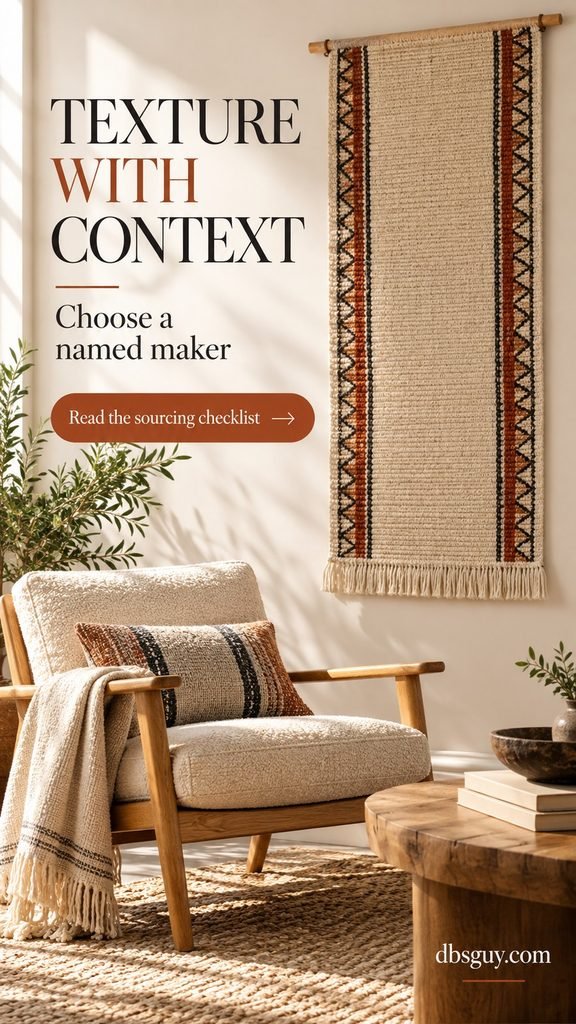
A wall textile can bring visible handwork into a room where a glossy print feels too formal. In this concept, a cream hanging with narrow rust and charcoal borders sits above an oak chair. Its restrained pattern leaves the weave itself visible.
Choose a piece whose maker, material, and intended use are explained. A textile designed as a wall hanging is an easier starting point than repurposing a garment or an object with unfamiliar significance. Do not cut up a meaningful textile simply to fit a frame.
Ask the maker or a textile framer how to support it without stressing the fibers. A suitable sleeve, supported rod, or professional mount may work; the right choice depends on the construction and condition. Avoid improvised glue or nails through the fabric. For valuable or fragile pieces, get advice before mounting.
Pair the hanging with plain upholstery and one wood tone so the texture stays visible. You can borrow the uncluttered furniture arrangements in our Japandi living room guide as a neutral backdrop while keeping the textile’s Ethiopian attribution clear.
3. Let one authorized print define a small corner

You do not need a whole wall or a large original. A smaller authorized print can make an apartment corner feel considered. The concept here uses one warm-toned print, a narrow shelf, two books, and a textured cream chair against blue-gray walls.
Choose the print because you like the work, then check the image dimensions separately from the paper size. A generous mat can help a modest print hold its own, but too much framing can overwhelm a narrow nook. Make a paper mockup before ordering a custom frame.
Keep the artist’s name and title in your purchase records. If you share your finished corner online, credit the artist and link to their official page when possible. Buy the print rather than downloading a museum or Pinterest image and sending it to a print shop without checking permission.
Leave enough room to sit down comfortably and reach the lamp. Our reading nook ideas for small spaces offer practical layout options around the art.
Treat sacred imagery as sacred imagery
If you are drawn to an Ethiopian Orthodox icon, first learn what it depicts and how it is used. Ask the iconographer, a knowledgeable seller, or an Ethiopian Orthodox parish about appropriate handling and display. Guidance from the relevant community matters more than a generic decorating rule.
A respectful editorial default is to give an icon an intentional, uncluttered place rather than use it as a casual styling prop. Avoid converting sacred imagery or text into disposable party decor, upholstery, or an invented “tribal” pattern. If you are unsure of the meaning, choose a secular work whose context you can understand.
The same care applies to religious writing from other traditions. Do not assume unfamiliar lettering is abstract decoration. Ask for the language, translation, and purpose before choosing it for a room.
Frame, place, and care for the actual work
Ask the artist or seller for medium-specific care advice. Paper, canvas, cotton, and mixed-media works need different treatment. Tell the framer what you have, and ask how the materials will be supported, protected, and removed later if necessary.
When choosing a location, ask about sunlight, heat, moisture, and any glazing needs. A kitchen splash zone, steamy bathroom, or wall above a working fireplace deserves particular discussion with the maker or framer. Do not apply a universal cleaning method to every medium.
This is a year-round decorating project. If you are refreshing a room for fall or holiday guests, change a throw or lamp shade around the work rather than treating the art as seasonal merchandise. Check lead times for international shipping and custom framing before planning around a gathering.
Frequently asked questions
Can I display Ethiopian art if I am not Ethiopian?
You can collect and appreciate an artist’s work thoughtfully. Buy through legitimate channels, credit the creator, learn the context, and listen to relevant community guidance about sacred objects. These are practical principles of appreciation, not a claim that one person can grant permission on behalf of every Ethiopian community.
What if I have a small budget?
Look for an authorized open-edition print or one clearly documented small textile. Include framing and delivery in the budget. One purchase with a clear origin is a stronger starting point than several anonymous accessories.
Do I need bright colors or rattan furniture?
No. Follow the work you choose. A monochrome print may suit a pale room; a colorful painting may look best with simple surrounding fabrics. Rattan is an optional material choice, not a requirement or proof of Ethiopian origin.
Can I mix Ethiopian art with other traditions?
Yes, while keeping the identities distinct. Describe each piece accurately rather than presenting Nigerian textiles, Moroccan rugs, and Ethiopian art as interchangeable. A shared color can connect a room without erasing where its objects come from.
Your first step: choose one artist or maker to learn about, confirm what you are buying, and mock up its placement. Build the room around that piece slowly enough to keep both its visual impact and its meaning intact.