21 New Year’s Eve Party Ideas With Themes, Games, and Midnight Activities


Give your New Year’s Eve party something guests can settle into, something they can play, and a reason to gather when the clock changes. A six-person supper, a living-room disco, and a pajama night all need different amounts of space and energy.
These 21 New Year’s Eve party ideas include seven themes, seven games with usable rules, and seven countdown or midnight activities. For a small apartment, try the midnight café, music guessing game, and one-word toast. For families, pair the pajama theme with cup stacking and an early countdown.

The images are AI-generated party concepts, not photographs of events hosted by dbsguy.com. Suggested group sizes and activity times are planning estimates; adjust them to your guests.
Seven Themes to Give the Evening a Direction
Choose the theme around what people will actually do. Dinner needs seats at a table; dancing needs clear floor space; a potluck needs somewhere to serve food. Then add the colors and decorations.
1. Host a Black-and-Gold Supper for a Small Group

Use a black runner, everyday white plates, and a few low gold-toned accents for a dinner that feels dressed up without filling the table. Six guests is a useful starting point if your table comfortably seats six. Check that the serving bowls fit before adding decorations.
Serve one main dish you already know how to make, a substantial side, and a dessert that can wait while you eat. The tart and salad in the concept show the scale of a small supper, rather than a complete menu for every appetite. Move to the sofa for a short quiz after dinner.
Make the invitation specific: “Dinner at 7:30; black, gold, or something you love wearing.” For more outfit options, browse 18 New Year Outfit Ideas for Casual Gatherings and Dressy Celebrations.
2. Turn One Living-Room Corner Into a Disco

A mirror ball, silver fringe, and a playlist can establish the theme in one corner. Use a stable stand or the manufacturer’s specified mounting method for any lighting equipment. Aim a suitable light at the mirror ball and check the effect before guests arrive; a mirrored decoration alone does not produce moving reflections.
Keep the middle of the room open, with seating around the edge and drinks on a separate table. Invite each guest to request one dance song before the party, then arrange those requests into a playlist. Leave enough ordinary room light for people to see the floor. This works best when dancing is the main event and the group is comfortable with the volume.
3. Make Pajamas and Cocoa the Dress Code

For close friends or a family gathering, set out blankets, popcorn, a deck of cards, and mugs for cocoa. Keep regular chairs available alongside cushions so guests can choose a comfortable seat.
Put hot drinks on a sturdy surface away from the game table, and let an adult handle hot pours when children are attending. If you show a movie, check its running time and start early enough to finish before your countdown. A card game can fill the gap afterward.
The room does not need a fireplace or a matching pajama purchase. Ask guests to wear something comfortable, and make the shared activity the part you prepare.
4. Build a Party Around One Decade’s Mixtape

Choose one decade and name it on the invitation. A 1990s night might use cobalt and yellow paper shapes, a denim dress suggestion, and a playlist of familiar songs from that period. Guests can join through the music even if they skip dressing up.
Ask everyone for two song requests ahead of time and save some recognizable tracks for the intro-guessing game in idea 9. A few generic cassette cases or a boombox can decorate a sideboard; there is no need to buy an entire set of retro props. Choose music your actual guests know rather than assuming everyone remembers the same hits.
5. Use Winter Starlight for a Quieter Celebration

Try midnight blue, white paper stars, and warm battery lights when you want a winter atmosphere that suits conversation. Hang lightweight decorations with suitable fixings, away from heat, and keep the food table mostly clear.
Serve sparkling white grape juice or another alcohol-free drink in the glasses you own. Instrumental music at conversation volume and a small puzzle table suit this theme. Keep overhead or task lights available for reading and moving around; decorative lights do not need to illuminate the entire room.
This is an easy direction to adapt if your holiday decorations already include white or silver pieces. Pack away the strongly Christmas-specific items and reuse a small selection.
6. Organize a Color-Pop Potluck With Assigned Dishes

Coral, teal, and yellow napkins can connect a table of very different dishes. Coordinate the menu by category: ask one household for a main, another for a vegetable side, another for bread, and another for dessert. Scale those assignments to the headcount instead of asking everyone to bring “anything.”
Have contributors send ingredient information and tell you whether their dish needs chilling, reheating, or hot holding. Bring out small portions with their own serving utensils and clear labels. The concept shows a first serving, with temperature-controlled backup food kept elsewhere.
Keep a simple list of who is bringing what. Check dietary needs before confirming dishes, and do not treat a label alone as protection against allergen cross-contact.
7. Open a Midnight Café at Home

Turn a dining nook into a small café with checked cloths, table lamps, a coffee-and-tea menu, and a modest pastry stand. Use your existing tables and chairs; even one dining table can become the café.
Offer decaf coffee, tea, and sparkling water, with cups and a clear place for used dishes. This theme suits a small group that wants to talk, draw, or play a short paper game. Put a few conversation cards on the table, such as “What was your best ordinary day this year?”
If the invitation starts late, say whether you are serving dessert or dinner. Pastries and drinks work as a late café menu when guests know to eat beforehand.
Also Read: 18 New Year Decoration Ideas for Tables, Entryways, and Party Backdrops.
Seven Party Games With Clear Rules
Pick one or two games and keep the rest as options. The suggested times below cover play, with a little extra room needed for explaining rules. Let guests watch, keep score, or pass if they prefer.
8. Run a Six-Question Year-in-Review Quiz

Suggested group: 4–16, in two or more teams. Allow: about 15 minutes. Prepare six questions, an answer key, and one sheet per team numbered 1–6.
Use a mix of questions about shared events and broadly recognizable entertainment. For example, show a photo from a group outing and ask for the location, or describe a movie released during the year and ask for its title. Verify dates and answers before writing the key. Avoid private jokes that exclude half the room.
Read all six questions, giving roughly 45 seconds for each answer, then swap sheets for scoring. Award one point per correct answer and accept equivalent wording. Let tied teams share the win or prepare one numerical tiebreaker whose closest answer wins.
9. Play Name That Intro Without a Buzzer

Suggested group: 4–12 in teams. Allow: 10–15 minutes. Queue eight songs and write down the titles and artists before the party. The person controlling playback sits out scoring.
Play about five seconds of each opening, pause, and let teams write a title and artist. Give one point for each, for a maximum of 16. Check answers after all eight tracks so one team’s shouted guess cannot help another.
Choose songs across your guests’ tastes, or stay within the decade theme. Avoid shuffling the prepared queue, and test your playback setup for ads, notifications, and volume changes. Announce a shared win for ties.
10. Guess Who Wrote Each Tiny Goal

Suggested group: 6–12 people who have had time to meet. Allow: about 15 minutes. Give each participant a paper slip and ask for one small goal they are happy to share, without a name.
“Learn to bake bread,” “visit a new park,” or “finish a jigsaw puzzle” give the group something light to guess. Mix the folded slips in a bowl. One reader draws and numbers each goal aloud; everyone writes a guess against that number, leaving their own goal blank.
Reveal the writers after the last slip and award one point for each correct guess. Everyone has the same number of scoring opportunities. Let ties stand, and keep sensitive topics out of the prompt.
11. Send Teams on a Five-Prompt Photo Hunt

Suggested group: pairs or small teams. Allow: 10 minutes. Write these five prompts on a sheet: something star-shaped, a reflection, three matching colors, a party hat, and a close-up that makes an ordinary object hard to recognize.
Teams take one photo for each prompt inside the agreed party area. Give one point per completed prompt, then let each team show its favorite image. Completed lists can share the win; the point is looking around together.
Keep bedrooms, medicine cabinets, and personal paperwork out of bounds. Photograph objects, and ask permission before including anyone. Guests can show pictures on their phones without uploading them or creating a shared account.
12. Try a 60-Second Cup-Stack Challenge

Suggested group: 2–10 taking turns. You need six identical empty paper cups and a stable table. Allow about five minutes for a small group, or longer if everyone wants a second attempt.
Start with all six cups nested in one stack. On “go,” build a pyramid with three cups on the bottom, two above, and one on top. Return them to one nested stack. That full build-and-collapse cycle earns one point.
Count completed cycles in 60 seconds; partial cycles do not count. Use both hands, reset fallen cups, and give everyone the same equipment and number of attempts. The highest count wins. For younger players, make completing one pyramid the shared goal, without racing.
13. Act Out Fresh-Start Charades

Suggested group: 4–12 in two teams. Allow: 10–15 minutes. Write these six prompts on separate cards: planting a garden, learning to swim, baking bread, packing for a trip, painting a room, and riding a bicycle.
One player draws a card and acts without speaking while their team guesses for 45 seconds. Award one point for a correct answer, then switch teams. Play three turns per team, rotating actors. Allow one replacement card per turn, returning the skipped card to the bowl.
Agree beforehand that seated acting is welcome. When the six turns are finished, the highest total wins; tied teams share the result. Add fresh prompts only if both teams want more rounds.
14. Make a Puzzle Sprint Cooperative
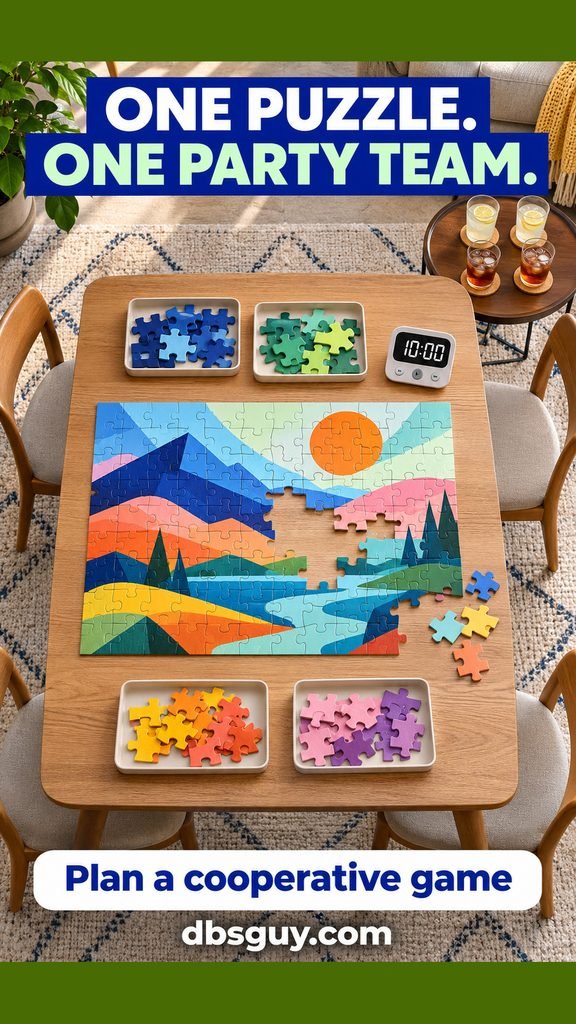
Suggested group: 2–6 around a reachable table. Allow: 10 minutes per round. Choose a large-piece puzzle that fits the table with sorting space. For a short round, set a partial-completion goal instead of expecting to finish the whole puzzle.
Everyone works on the same puzzle. Set one goal before starting: connect the border, complete a recognizable section, or add 20 correctly joined pieces. Stop when the timer rings and celebrate whatever the group completed.
Use shallow trays to sort colors and leave drinks on side tables. Keep the puzzle out for guests who want a quiet activity later. Choose age-appropriate pieces if children are joining, and let the group finish without a timer if that is more enjoyable.
Also Read: 21 Easy New Year’s Eve Appetizers, From Warm Dips to Bite-Size Snacks for food you can serve between rounds.
Seven Countdown and Midnight Activities
Choose the moment you want everyone to share, then prepare it before the room gets busy. One person should watch the clock and gather guests; another can handle music or the camera.
15. Open Four Countdown Envelopes

Label four envelopes 9:00, 10:00, 11:00, and 11:45. Put one short instruction inside each: choose the next song, start a game, bring out dessert, and prepare the countdown. Adjust the times if your party begins earlier.
Leave the envelopes together on a shelf where the host can see them. Set phone reminders so nobody has to stare at the display. The final card can say, “Find your drink, check the clock, and gather in the living room.”
This gives the evening a few anchors while leaving conversation room to continue. If everyone is enjoying an activity, move an envelope’s task later; only the actual countdown needs its fixed time.
16. Give Children an Early Countdown
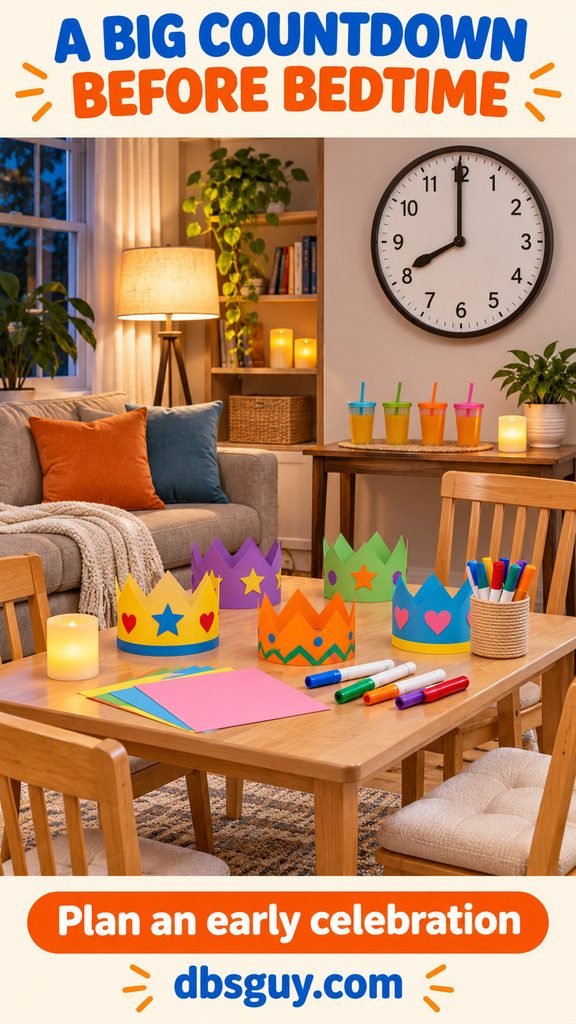
Pick a celebration time that fits the children attending, such as 8 p.m., and include it on the invitation. Call it the family’s early countdown so nobody needs to pretend it is midnight.
Have an adult prepare paper crown bands, then let children decorate with broad washable markers and age-appropriate supplies. Fit the bands comfortably with adult help. Keep juice cups on a separate stable table while everyone crafts.
Count backward from ten together, put on one favorite song, and take a photo. Children can clap or wave their crowns instead of using loud noisemakers. Keep small craft scraps out of reach of children who may put them in their mouths, and let families head home on their own bedtime schedule.
17. Share a One-Word Midnight Toast

Put out cards with a few examples—calm, play, courage, rest—and invite each guest to choose or write one word for the year ahead. Collect the words before midnight if the group is large, or let a small circle share them after the countdown.
Give each person one sentence at most, with passing always welcome. The host can close with, “Here’s to more of what matters to each of us.” Offer water and an alcohol-free sparkling drink alongside anything else you serve.
This suits a quieter group and does not need a public resolution or a speech. Guests can keep their cards as a reminder or leave them behind without explanation.
18. Seal a Time Capsule to Open Next New Year’s Eve

Set out a small keepsake box, envelopes, and three prompts: “An ordinary moment I want to remember,” “Something I learned,” and “A question for my future self.” Guests can add a printed photo or a ticket stub if they choose.
Let each person seal private writing in an envelope. Agree on who will keep the box, where it will stay dry, and how absent guests can receive their envelopes next year. Write the intended opening date on the box before sealing it.
Keep food, valuable originals, and anything irreplaceable out of the capsule. You can seal it just after midnight, once everyone has finished, rather than rushing the writing during the countdown.
19. Take a Midnight Freeze-Frame With the Host Included

Set a phone on a secure tripod facing the group’s photo spot. Check the frame and lighting earlier with someone sitting or standing where guests will be. Include normal chairs for anyone who prefers to sit, and keep the tripod out of the walking route.
After the countdown, gather for one smiling picture and one playful freeze-frame. Use the phone’s timer so the host can join; test that setting beforehand. Taking the photo a minute after midnight gives everyone time to enjoy the actual moment.
Ask before sharing pictures, and keep posting optional. A photo sent privately to the people in it can be the whole keepsake.
20. Make a Small Paper-Confetti Moment

For a group that wants a little movement at midnight, put a small amount of large tissue-paper squares in plain paper cups. Use a clear corner with an easy-to-clean floor, away from food, drinks, heat, and fragile decorations.
At zero, guests can gently toss a pinch upward while leaving cups on the table. Skip glitter and metallic scraps. Test a few tissue pieces first to make sure they will not mark the floor, and sweep up immediately afterward.
Keep the paper away from small children and pets. If tossing paper does not suit your home, wave the one-word cards from idea 17 instead. The countdown still has a shared visual moment.
21. Bring Out Breakfast After Midnight

A small tray of mini bagels and plain breakfast pastries makes a relaxed final bite. Keep it separate from the earlier snack service so you can set out clean plates, tongs, jam, decaf coffee, and tea after the toast.
As a starting estimate for eight adults who have already eaten, set aside eight mini bagels and eight small pastries, then adjust to appetites and what else you served. Keep any cream cheese or other perishable additions refrigerated until needed and serve small portions.
Ask one helper to bring out the tray around 12:10 so you can stay with the countdown. Tell guests your planned finishing time on the invitation; a breakfast bite can be a pleasant last chapter before goodbyes.
Also Read: How to Plan a New Year’s Eve Party From Invitations to Midnight.
Put Your Choices Into One Manageable Evening
For an example party starting at 8:30 p.m. after dinner, open with the café theme, run the music game around 9:30, leave the puzzle available during conversation, and share the one-word toast at midnight. These times are suggestions, not a schedule you need to fill.
- Before guests arrive: set up the food, check your speaker and camera, put game supplies together, and agree on rides home if alcohol is being served.
- About 15 minutes before midnight: finish active games, put out clean cups, and gather guests in the countdown area.
- For the countdown: use one clock set to local time. Test any live coverage in advance and check which time zone it follows; streams may lag behind the clock.
- After the toast: take the group photo, bring out the final snack if planned, and let guests settle back into conversation.
A long party also needs a food-serving plan. Follow the FDA’s buffet guidance: keep hot foods at 140°F or above and cold foods at 40°F or below, checking with a food thermometer. Discard perishables left without adequate temperature control for more than two hours, or one hour above 90°F. Count preparation and display time together; putting a tray back in the refrigerator does not reset that time.
Replace nearly empty dishes with clean, freshly filled ones rather than topping them up. Keep backup portions properly chilled or hot, and retain ingredient information for guests with dietary needs.
Questions That Help You Choose
What can a small group do on New Year’s Eve?
Choose a supper or café setup, one short game, and a shared countdown. Music guessing works with two teams of two; a cooperative puzzle works with just two people. For a very small group, skip scoring and enjoy the answers together.
How do you keep the party affordable?
Use a theme built around dishes, lighting, and clothes you already own. Paper games need little equipment, and an assigned potluck can spread the cooking. Decide what you can spend before choosing food and decorations, then check current local prices for that menu.
How many games should you plan?
Have one ready to start and one in reserve. If dinner or dancing fills most of the night, a single short game may be plenty. Stop a game early enough that everyone can get ready for the countdown without rushing.
How can the celebration work without alcohol or loud noise?
Use the winter-starlight or café theme, offer appealing alcohol-free drinks, and choose a puzzle, tiny-goal game, or one-word toast. Count down together at a comfortable volume. Confetti, horns, and a television broadcast are optional.
Also Read: New Year Party Planning Guide: Themes, Food, Games, and a Countdown for help turning your favorite ideas into a fuller hosting plan.