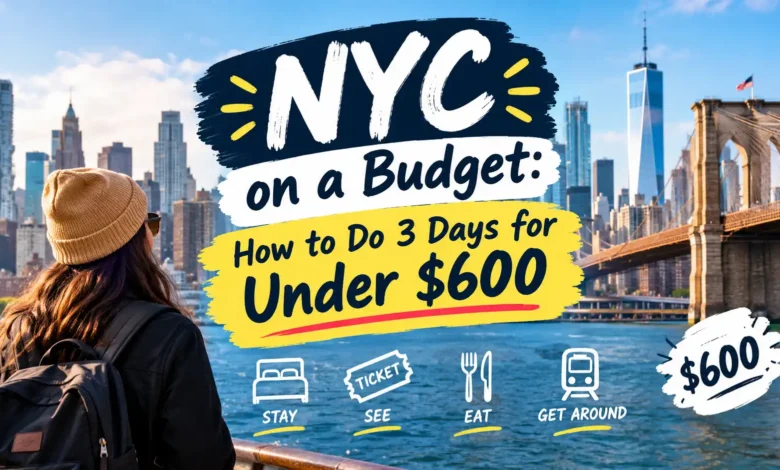
Yes, you can plan three days in NYC for under $600 per person—with two nights of lodging, casual meals, public transit, and mostly free sightseeing. The sample budget below totals $570, including a $75 flexible reserve. The deciding factor is your room: keep the complete two-night accommodation bill at $340 or less.
This is a solo travel planning budget in U.S. dollars, not a booked package or a guarantee of hotel availability. It excludes your flight, intercity train, or bus to New York. It assumes you arrive early on Day 1 and leave late on Day 3. If those travel times require a third hotel night, add that cost before booking.

Prices and admission policies checked October 11, 2026. Meal and lodging amounts are spending targets; your actual dates and purchases determine the final total. The visuals are AI-generated travel concepts, not photographs documenting a trip or a specific hotel.
The $570 NYC budget: what it actually includes
Start with the biggest expense, then divide the rest into amounts you can track without doing math at every subway gate.
- Accommodation: $340. Two nights at a maximum of $170 per night, including taxes and mandatory fees. A private budget room is a possibility on suitable dates; a hostel bed or a shared room may be necessary when private-room prices are higher.
- Food: $120. Three days at $40 a day for simple breakfasts, casual lunches, takeout dinners, and small extras, including applicable tax and any tips.
- Subway and local buses: $35. A conservative allowance using the same eligible contactless payment method throughout the trip. The LaGuardia subway connection fits within this allowance.
- Base itinerary admission: $0. Midtown landmarks, the Staten Island Ferry, the Brooklyn Bridge walk, Brooklyn Bridge Park, and Central Park.
- Flexible reserve: $75. Optional admission, a JFK AirTrain charge, luggage storage, a meal overrun, or another small expense. These share one allowance.
Total: $570 per person. That leaves another $30 before you reach $600. The reserve is already included in $570; spending it does not automatically add $75 to your total.
At the maximum planned spending, your trip is roughly $190 per day when the two hotel nights are spread across all three days. That average is useful for planning, but your lodging payment may happen all at once.
Book the room first: the two-night $340 rule
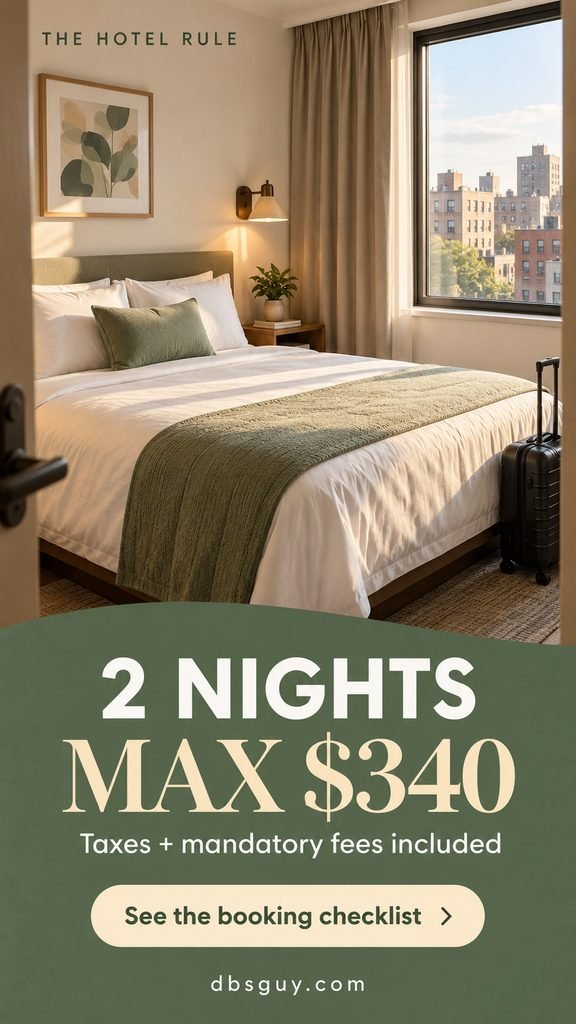
A cheap pizza lunch cannot rescue a hotel bill that uses the entire trip budget. Before choosing attractions, find lodging that fits the all-in two-night ceiling.
Start your search around Queens Plaza or Court Square in Long Island City, then compare smaller Manhattan rooms and established hostels. These are search areas, not promises of cheaper rooms. Check the walk from the actual property to a station and the journey to Midtown; a listing labeled “New York area” can be much farther away than it sounds.
For a standard NYC hotel room costing at least $40 a night, a useful tax estimate is 14.75% of the room charge plus $3.50 per room per night, before any property-specific fees. The NYC hotel tax guidance explains the city tax and fixed charge, while New York State’s lodging guidance covers state-administered charges.
For example, $145 × 2 nights = $290 before tax. Adding approximately $42.78 in percentage taxes and $7 in nightly charges gives $339.78, assuming no additional mandatory fees. This is a calculation showing the target rate, not a live hotel quote.
Compare the final checkout total, cancellation terms, bathroom arrangements, recent reviews, and luggage storage policy. A refundable incidental deposit is not the same as a room expense, but it can temporarily tie up money on your card.
If rooms exceed the ceiling: compare different dates, consider a hostel if the setup suits you, or share a room. If two adults split the same $340 two-night room bill, lodging becomes $170 each and this model drops to $400 per person, with the other allowances unchanged. Confirm the price for two occupants.
Use public transit—and price the airport separately
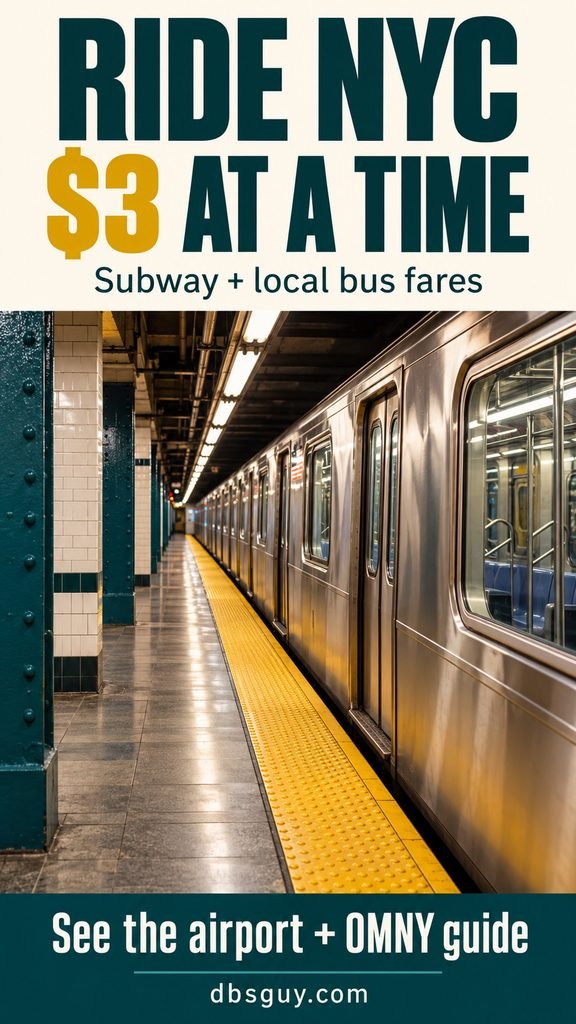
The MTA’s current subway and local-bus fare is $3 for most riders. Tap an eligible contactless card, phone, wearable, or OMNY Card. You do not need to buy an unlimited pass for this plan.
Eligible subway and local-bus spending is capped at $35 in a rolling seven-day period when you consistently use the same card or device. If you only take eight paid rides, you spend $24; $35 is the ceiling for eligible trips, not an upfront purchase. Use your physical card or your phone consistently, because they track separately. Each traveler should use their own payment method for their own cap.
Arriving at LaGuardia
The LaGuardia Link Q70 bus is free. From Terminals B or C, ride it to the Jackson Heights–Roosevelt Avenue/74 St–Broadway subway connection, then take the appropriate subway toward your hotel. The subway costs $3 before any cap applies. Terminal A travelers need the airport shuttle to Terminal B for the Q70. Check current service before leaving.
Arriving at JFK
The JFK AirTrain fare at Jamaica or Howard Beach is $8.75 each way, plus the subway fare. Its fare is separate from the subway/local-bus cap. For a solo traveler, allow $17.50 round-trip for AirTrain from the $75 reserve; the connecting subway rides use the transit allowance. LIRR is a separate fare if you choose it.
If you prefer to preserve the full reserve, adding JFK AirTrain on top makes this model $587.50, still below $600. Newark uses a different transport system and needs its own airport-transfer quote; do not apply the LaGuardia or JFK figures to it.
Before each journey: check the train’s destination and current service changes. For accessibility needs, check station elevators and outages before selecting a route. Build in time for luggage collection and transfers rather than planning sightseeing right up to your flight’s boarding time.
Day 1: Midtown landmarks without admission tickets
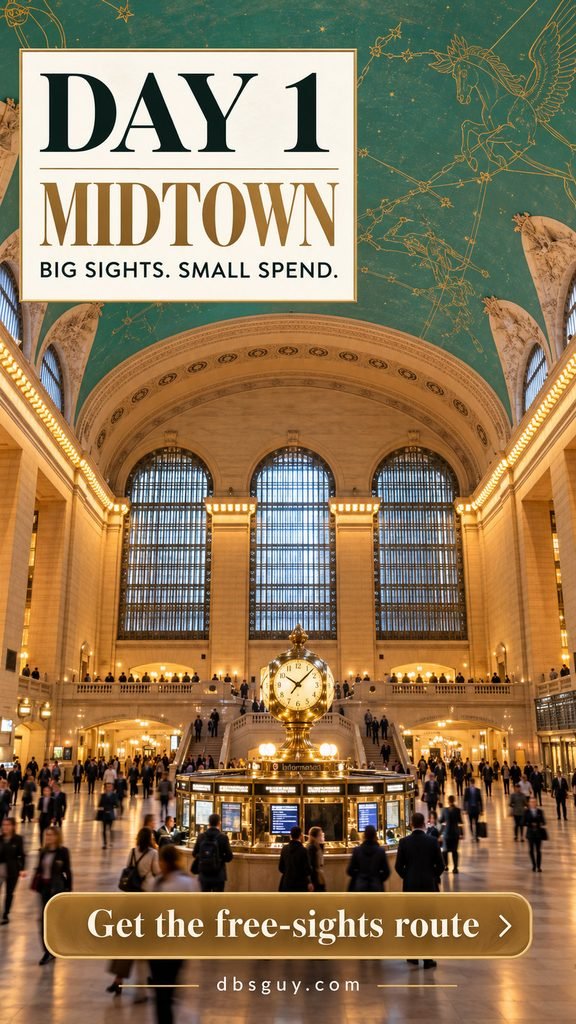
Route: Grand Central Terminal → New York Public Library and Bryant Park → Fifth Avenue and Rockefeller Center → Times Square.
Planned spending: $40 for food; admission $0. Transit comes from the trip’s $35 allowance.
Late morning: Grand Central, then the library
After dropping your bag at the hotel if permitted, start at Grand Central’s Main Concourse. Look up at the celestial ceiling, then find the brass clock above the information booth. A self-guided look at the public concourse gives you the setting without paying for a tour.
Walk west along 42nd Street to the Stephen A. Schwarzman Building of the New York Public Library. Explore the public visitor areas and the free Polonsky Exhibition when open. Check that day’s visitor hours; access to working reading rooms follows separate rules.
Afternoon: lunch, Bryant Park, and Fifth Avenue
Pick up a casual lunch nearby and pause at Bryant Park. Then walk north on Fifth Avenue toward Rockefeller Center. Enjoy the streetscape and public plaza, keeping observation-deck tickets and seasonal skating outside the base plan.
A bagel breakfast, a pizza or sandwich lunch, and a takeout dinner make the $40 food target easier to manage than three table-service meals. Check menu totals before ordering, especially around heavily visited landmarks.
Evening: a short Times Square visit
Finish with the billboards after dark, or at dusk if you are tired from traveling. You can enjoy the atmosphere without shopping or buying a show ticket. Eat dinner away from the busiest stretch when convenient, then head back to rest.
Make it manageable: this is a half-day-to-evening route, with walking spread between stops. If your arrival is delayed, prioritize Grand Central, the library area, and Times Square. Treat Rockefeller Center as the flexible stop.
Day 2: the harbor, Chinatown, and a Brooklyn waterfront finish
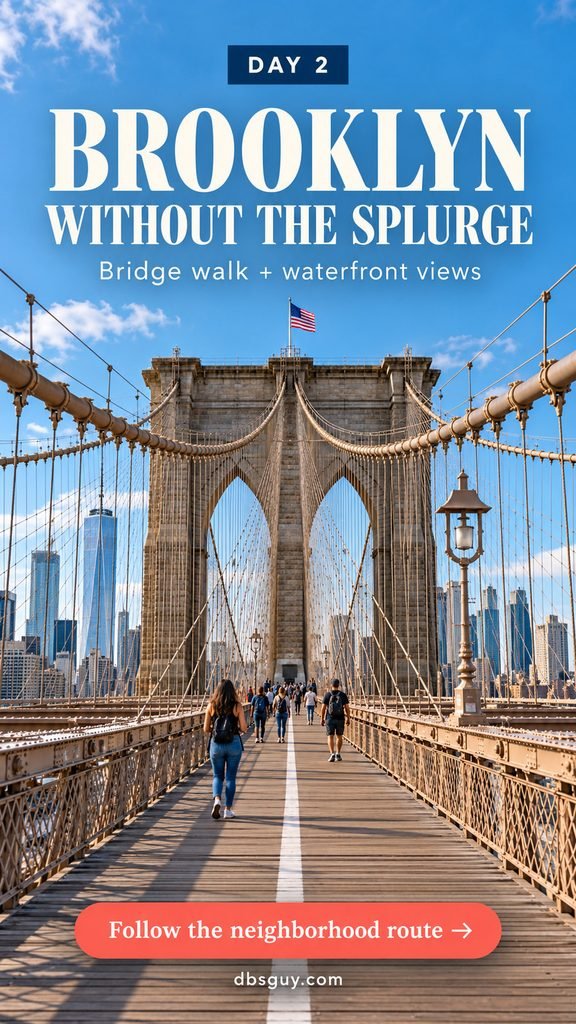
Route: Whitehall Terminal and the Staten Island Ferry → Chinatown → Brooklyn Bridge → DUMBO and Brooklyn Bridge Park.
Planned spending: $40 for food; admission $0. This is the longest walking day, so use transit for the larger gaps.
Morning: a free harbor ride
Take the subway to Lower Manhattan and board the free Staten Island Ferry from Whitehall Terminal. It is a public transportation service with skyline and distant Statue of Liberty views, not a Liberty Island tour.
Allow roughly 60–90 minutes for the return outing, depending on boarding and departures. Follow instructions to disembark at St. George and rejoin the return boarding queue. Check the official schedule rather than assuming you can stay aboard or immediately catch the next boat.
Lunch: Chinatown, with the price checked first
Head north to Chinatown for a casual noodle, rice, or dumpling meal. Use a short subway connection or walk if your energy allows. Look at the posted menu and whether the price is per item, portion, or meal; ordering several small plates can cost more than one filling dish.
Give yourself time to browse a few streets before heading toward the Manhattan pedestrian entrance to the Brooklyn Bridge near City Hall. Chinatown is the lunch stop, not a reason to race across several neighborhoods.
Afternoon: walk to Brooklyn, then slow down
Cross toward Brooklyn on the pedestrian walkway, allowing about 45–60 minutes with photo pauses. Once across, walk down to DUMBO. Enjoy the neighborhood’s brick buildings, then spend the remaining afternoon along the waterfront.
Brooklyn Bridge Park has free entry, so you can watch the skyline from the shoreline without booking a boat tour or rooftop table. Keep paid extras such as carousel rides outside the $0 sightseeing line.
Choose a casual dinner within your remaining food allowance, then take the subway back instead of walking the bridge again. Aim for the waterfront before sunset in winter.
Shorter version: skip the ferry and start with Chinatown if the weather is harsh or you want less walking. If the bridge crossing is too much, take the subway to Brooklyn and keep the park visit. You still get the neighborhood-and-skyline day.
Day 3: Central Park, one optional museum, and an unhurried departure
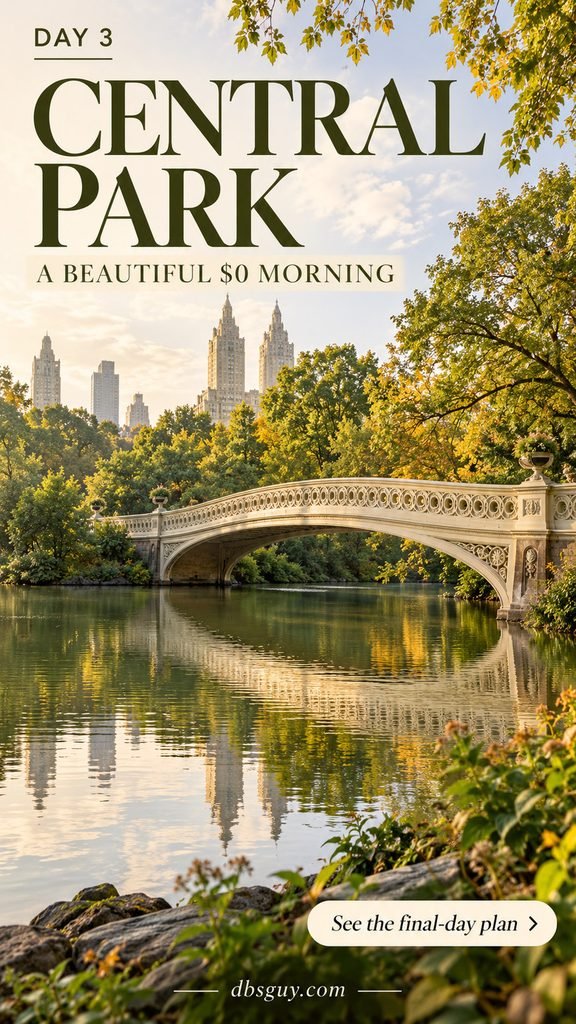
Route: Central Park South → the Mall and Bethesda Terrace → Bow Bridge → the Upper West Side → luggage pickup and departure.
Planned spending: $40 for food; base admission $0. An optional museum comes from the reserve.
Morning: a compact Central Park walk
Check out and confirm your luggage arrangement before sightseeing. Enter the southern part of Central Park, stroll up the Mall, and continue to Bethesda Terrace. Then wander toward Bow Bridge for the lake views.
Allow two to three hours including pauses, and save a map so you can find the exit you need. You do not have to cover the entire park. A short route with time to sit is more useful on departure day than a long loop that ends far from your bag.
Lunch and a weather-dependent afternoon
Exit toward the Upper West Side for a casual lunch. With good weather and an early departure, finish with a neighborhood stroll and head back for your luggage.
For rain or a late flight, consider replacing part of the park walk with the American Museum of Natural History. Its standard adult general admission is currently $37 for visitors outside New York State. New York State residents have a separate pay-what-you-wish policy with eligible ID; visiting from another state does not qualify you.
The museum is optional, and ticketed exhibitions cost extra. Reserve the appropriate ticket and allow enough time to enjoy the visit. If your flight leaves early, shorten the day instead of squeezing in a museum.
Departure rule: work backward from your airline’s recommended airport arrival time, then add the hotel luggage stop and a realistic transfer margin. An inexpensive subway journey still needs time.
How to make the $40 daily food budget work

Use this as a spending pattern, not a claim that every NYC restaurant sells meals at these prices:
- Breakfast: $8. A simple bagel and modest coffee order, or groceries if your accommodation setup suits them.
- Lunch: $12. Pizza slices, a sandwich, or a casual lunch special after checking the menu.
- Dinner: $16. A filling counter-service or takeout meal such as noodles, a rice bowl, or another posted-price option.
- Small extras: $4. A snack, drink, or adjustment when a meal costs a little more.
Total: $40 a day, including applicable tax and any tips. These are checkout spending ceilings, not pre-tax menu prices. If your breakfast costs $11, reduce a later purchase or move $3 from the reserve.
Choose meals near the route you are already walking. Crossing town for a supposedly cheap lunch can use both time and transit money. Alternate familiar NYC staples with meals that fit your appetite; an all-pizza weekend is not required.
Repeated specialty coffees, delivery charges, cocktails, and table-service dinners make this target harder. If a sit-down dinner matters to you, price the complete meal and use a deliberate portion of the reserve.
Choose your extras from the same $75 reserve
You can add something memorable without losing track of the budget. The important part is using one shared pool:
- JFK AirTrain round-trip: $17.50 leaves $57.50 in the reserve.
- One standard AMNH adult ticket: $37 leaves $38.
- Both together: $54.50 leaves $20.50 for other extras.
Broadway, an observation deck, shopping, and a special dinner are separate choices. Use their actual checkout prices before committing. Do not assume several discounted tickets will all fit into $75, and avoid buying a multi-attraction pass before comparing it with the experiences you genuinely want.
A quick booking checklist before you commit
- Count the nights. This plan covers two, even though you explore on three calendar days.
- Check the room’s final total. Keep it at $340 or less for this version, including mandatory fees.
- Price the full journey to NYC. Add your flight or intercity ticket to the ground budget if you need a complete vacation total.
- Compare nearby dates. Treat holiday periods, major events, and popular weekends as dates that need extra price checking. Do not assume pleasant fall weather means inexpensive hotels.
- Check luggage arrangements. Any storage charge comes from the reserve.
- Save the route and official links. Recheck admission policies, opening hours, and transit changes close to departure.
NYC on a budget: common questions
Does the $600 include flights?
No. The $570 model covers spending in New York for one person, including two nights of lodging. Your flight, intercity rail, or bus fare is additional. An under-$600 total including transportation to the city would require a cheaper room or hostel, a lower-cost ticket, or spending cuts based on your starting point.
What if I need three hotel nights?
At the modeled all-in rate of $170 per night, a third night brings the budget to $740. To retain the $570 model with three nights and the same other allowances, lodging would need to average about $113.33 all-in per night. Check a hostel or a shared room, or raise the budget.
Can two people do the whole trip for $600 combined?
That is a different budget. If two people share the $340 room and each uses the $120 food, $35 transit, and $75 reserve allowances, the combined total is $800. The title’s under-$600 target is per person.
Is the Staten Island Ferry the same as visiting the Statue of Liberty?
No. It provides harbor views during the crossing and does not land at Liberty Island or Ellis Island. If visiting those islands is a priority, price the authorized tour separately and adjust the itinerary.
Will the $35 OMNY cap include every train or ferry?
No. It covers eligible subway and local-bus travel using the same payment method; JFK AirTrain, LIRR, and paid ferry services have separate fares. The Staten Island Ferry in this route is free.
Build the trip around the room you can actually book. Once that bill fits, keep the neighborhoods grouped, track food against $40 a day, and decide which extra deserves your reserve. That gives you a clear path to three satisfying days in New York without treating every famous landmark as a ticket purchase.