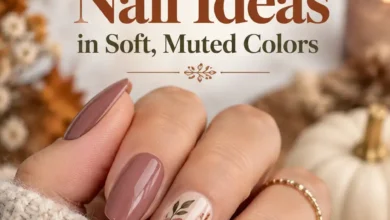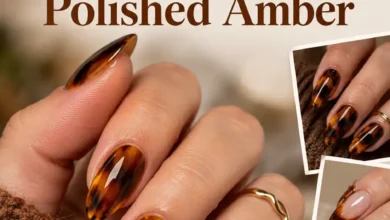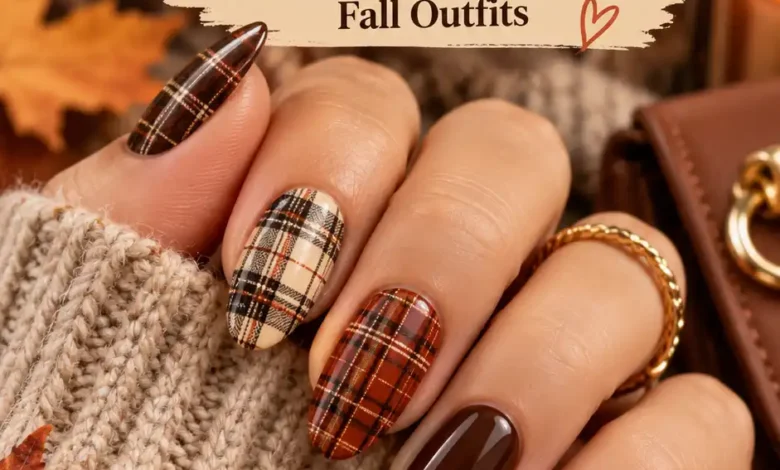
A checked cuff, a favorite scarf, a beautifully cut coat. There is a manicure hiding in each one.
Some fall outfits work because of one small detail: the checked shirt under a plain jacket, the stripe in a scarf that picks up the color of your boots. Plaid nails can do the same thing. A few crossing lines make a simple manicure feel as considered as the rest of your outfit.
These 21 plaid November nail ideas take that wardrobe approach. There are roomy coat checks, soft gingham, tiny French-tip plaids, and a mixed set that looks like a collection of favorite layers. Each look includes an outfit pairing and a salon note, along with advice on the detail worth preserving when you adapt it to your own nails.
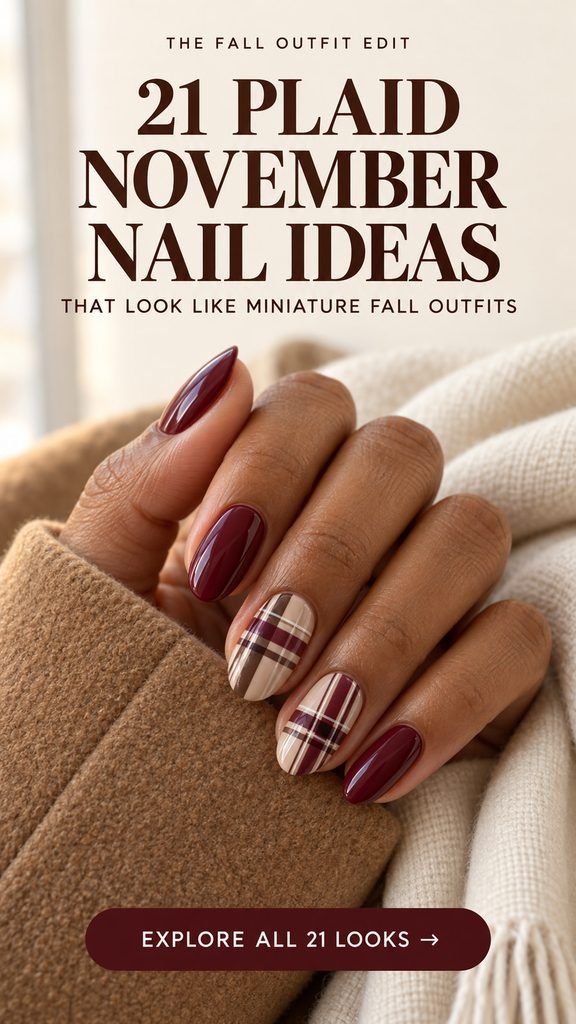
What Makes Plaid Work on a Small Nail?
The spacing matters as much as the colors. In Essie’s Uniform Plaid tutorial, broad vertical and horizontal bands establish the pattern before a striping brush adds finer lines. That is a useful way to think about your reference: identify the main bands first, then decide which small lines make the design feel complete.
A narrow nail does not need a shrunken copy of every stripe in a scarf. One strong crossing, a couple of fine companion lines, and some visible background may communicate the print more clearly. A roomy check feels bolder; a fine repeat feels quieter from a distance. Neither requires a long extension to be an option.
Choose the amount of artwork before the appointment. Two accent nails, patterned tips, and a full plaid set involve different amounts of detail. Nail artist Elina’s SoNailicious tutorial recommends practicing the lines and considering one or two accents when learning the pattern. A practice tip also gives you and your artist a useful place to agree on stripe width and scale.
The names below describe design directions, not exact reproductions of particular fabrics. The shared idea is a small network of crossing stripes or checks. Use the images to choose the placement, then select real polish swatches for the colors you will wear.November plaid nail idea 01 / 21
1. Camel Trench-Coat Plaid
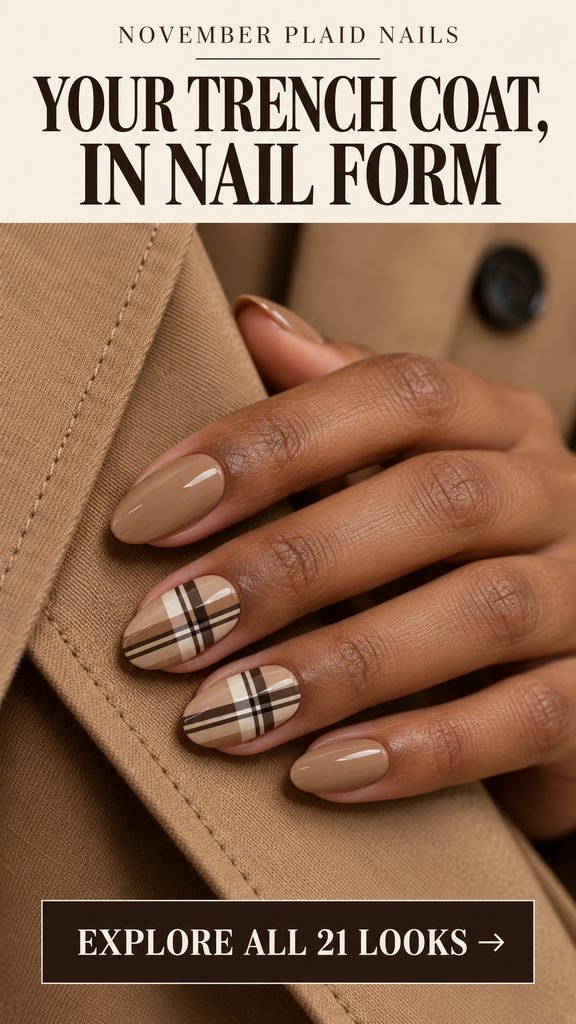
This is the manicure version of reaching for a camel coat because it makes everything else look a little more pulled together. The two plaid accents bring ivory and espresso into the warm base, while the plain nails keep the set easy to take in. There is enough contrast to see the pattern without losing that soft neutral feel.
Let the cream bands be wider than the dark lines. If every stripe has the same weight, the design can look like a basic grid. For a smaller nail, keep one strong crossing and its fine companion lines rather than squeezing in another repeat. A glossy finish gives the simple camel nails their own quiet appeal.
Wear it with: A camel coat, a cream top, and dark denim; repeat the warm brown in your shoes or bag if you like.
Salon note: Glossy camel nails with two ivory-and-espresso plaid accents. Mix broad light bands with fine dark lines and leave visible camel space around the crossings.November plaid nail idea 02 / 21
2. Denim-Blue Shirt Plaid
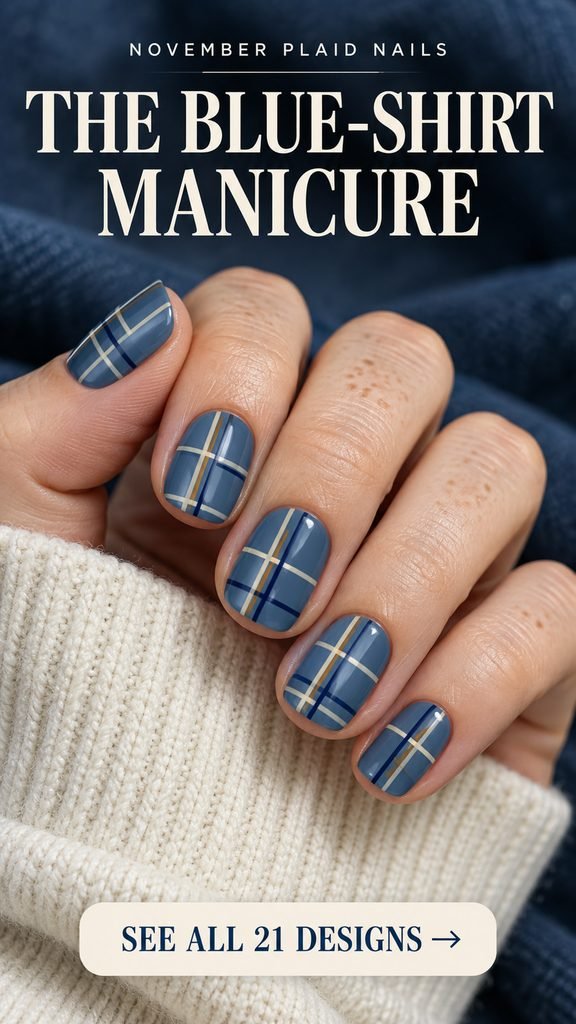
Denim blue makes plaid feel relaxed, like a checked shirt tucked into your favorite jeans. Cream lines brighten the base, dark indigo adds structure, and the tiny ochre stripe is the detail that stops the colors from feeling too cool. The short shape keeps the whole look practical and unfussy.
Choose a blue that still looks visibly blue away from bright studio lighting. When the base is too dark, the indigo lines may disappear. Keep the ochre finer than the cream so it reads as a small thread through the pattern. If you want less artwork, retain the complete plaid on two nails and repeat the denim shade elsewhere.
Wear it with: Straight-leg jeans, an ivory shirt, and a tan belt; the small warm stripe ties the colors together.
Salon note: Short denim-blue nails with fine cream and indigo plaid, plus one narrow ochre line. Keep the intersections clear and the ochre detail restrained.November plaid nail idea 03 / 21
3. Oxblood-and-Blush Blanket Plaid
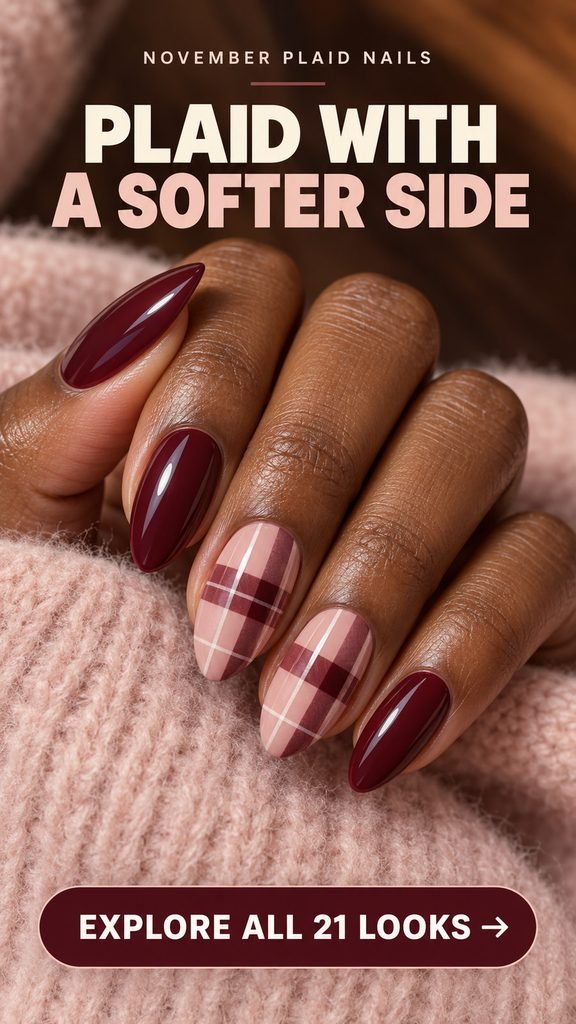
Oxblood gives this blanket plaid its depth, but blush is what makes it feel inviting. The wider bands overlap across the accent nails, creating darker little intersections, while fine ivory lines keep the layout crisp. Solid oxblood on the other fingers makes the pale details feel especially deliberate.
Ask for a dusty blush rather than a very bright pink if you want the softer effect shown here. The plaid should have a few large areas of color, not a dense mesh of stripes. On narrow nails, use one broad vertical band with two crossings. You will keep the blanket-check impression without covering every bit of pink.
Wear it with: A blush scarf over a dark coat, or an oatmeal sweater with a burgundy bag.
Salon note: Two dusty-blush plaid accents with broad oxblood crossing bands, deeper intersections, and fine ivory lines. Pair them with plain glossy oxblood nails.November plaid nail idea 04 / 21
4. Olive-and-Ecru Gingham
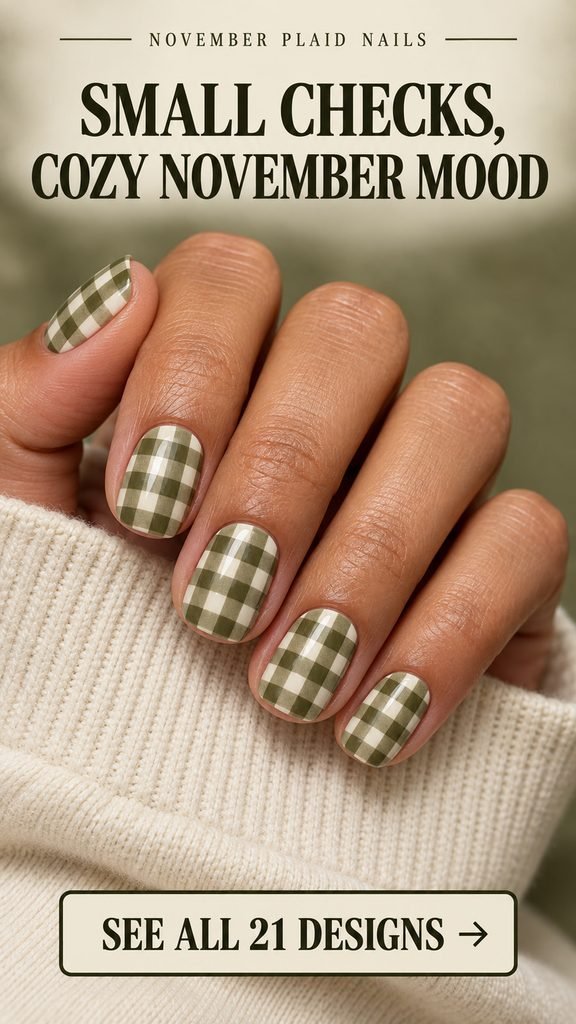
Olive gingham has a different personality from a bold multicolor plaid. The equal-width bands create a small, steady repeat, and their darker intersections give the checks depth. In olive and ecru, a pattern that could feel summery becomes a quiet November option.
The important detail is the three-tone effect: light background, medium bands, darker crossings. Alternating two solid colors alone would give you a checkerboard instead. For short nails, choose a few readable squares across the width. Keeping the checks slightly larger is often more effective than trying to fit an entire shirt pattern onto every finger.
Wear it with: An ecru sweatshirt, olive trousers, and simple brown shoes; let the small checks supply the pattern.
Salon note: Short olive-and-ecru gingham nails with equal-width crossing bands and darker olive intersections. A clear three-tone check, with no dark outline around each square.November plaid nail idea 05 / 21
5. Grey Blazer Plaid
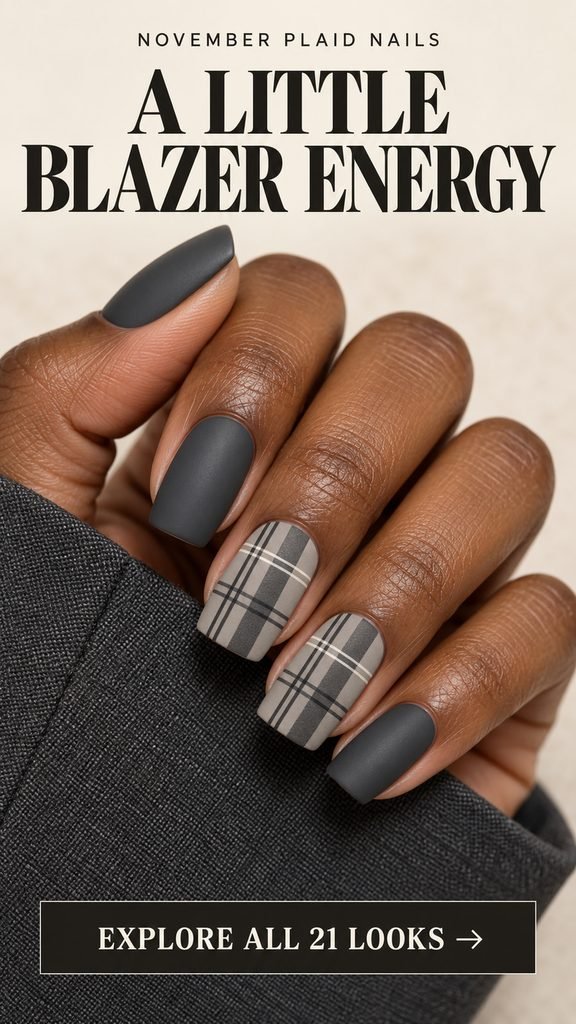
Grey blazer plaid borrows the precision of tailoring. Fine charcoal lines, a smoky band, and little ivory highlights give the accent nails a suiting-inspired pattern. Matte charcoal on the other nails makes the whole set feel composed, even when the artwork itself is quite detailed.
Ask your artist to show you the line spacing at your actual nail size. A pattern that looks beautiful enlarged on a screen may need fewer paired stripes on your hands. The design does not need to reproduce a particular fabric weave exactly. What matters here is the balance between a quiet grey background and sharper, darker checks.
Wear it with: A charcoal blazer over a white tee, with black trousers or dark jeans for an easy tailored combination.
Salon note: Two dove-grey suiting-plaid accents with paired charcoal lines, a smoky band, and fine ivory details. Plain matte charcoal on the remaining nails.November plaid nail idea 06 / 21
6. Terracotta Plaid Side Panels
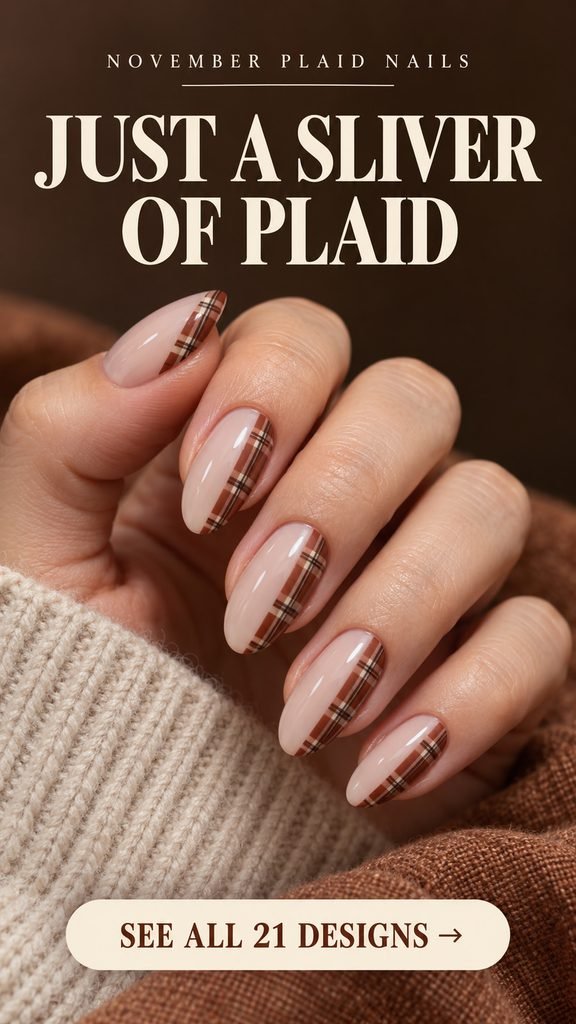
A narrow terracotta panel gives you the pattern without taking over the nail. Most of the sheer beige base stays visible, so the plaid feels like a glimpse of a checked lining when a coat moves. It is a useful middle ground between a plain manicure and a fully patterned set.
The panel needs enough width for at least one clear crossing. If your nail is very narrow, let the plaid take a little more than a third instead of making the lines microscopic. Keep its inner edge straight and clean; that boundary is what makes the tiny print look intentional. The transparent-looking space beside it is part of the design.
Wear it with: A pale knit with terracotta or tan accessories; the small colored panel gives a subtle echo of the outfit.
Salon note: Sheer milky-beige nails with narrow terracotta side panels containing fine cocoa-and-cream plaid. Keep most of the base open and the panel edge crisp.November plaid nail idea 07 / 21
7. Plum Scarf Plaid
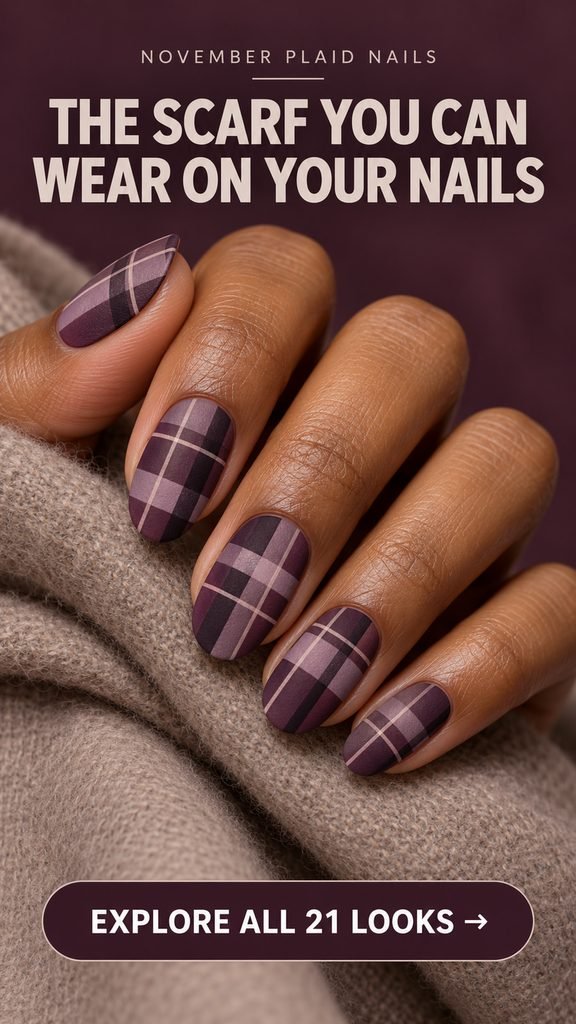
Plum scarf plaid is rich without needing shimmer. Broad lilac and aubergine bands move across the muted base, while the fine taupe lines add a lighter thread. The matte finish gives the colors a soft look that suits the scarf inspiration.
Varying the widths is what gives this pattern its rhythm. Keep one band broad, another narrower, and the lightest detail very fine. If the complete set feels busy, wear the plaid on alternating nails with solid plum between them. You can keep the same palette and change the amount of pattern without losing the mood.
Wear it with: A grey coat with a plum scarf, or a simple black sweater when you want the nail colors to stand out.
Salon note: Matte plum plaid with broad dusty-lilac and aubergine bands, plus fine pale-taupe overcheck lines. Preserve different stripe widths and visible spaces between them.November plaid nail idea 08 / 21
8. Espresso Plaid French Tips
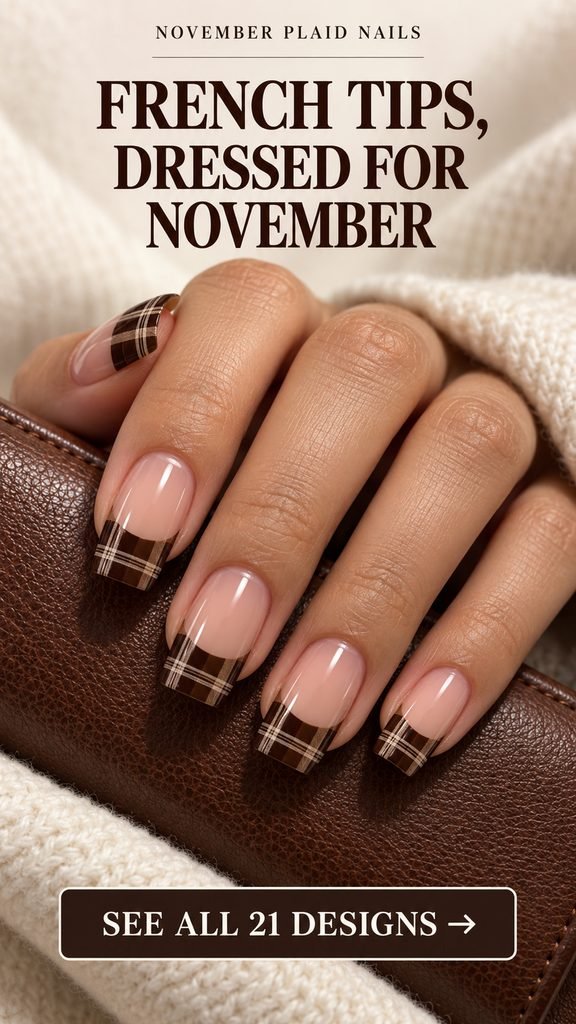
Espresso plaid tips give a French manicure the feel of a checked cuff peeking out from a sleeve. The sheer base stays light, and the latte bands make the dark edge more interesting than a single solid color. Fine ivory stripes add the last bit of definition.
There has to be enough depth in the tip for the lines to cross. Before choosing a very thin French edge, ask which part of the plaid would still be visible. One clear intersection is a better goal than several compressed rows. If you prefer a narrower tip, use fewer lines and let the espresso-and-latte contrast carry the idea.
Wear it with: A cream button-down under a brown jacket, or a plain beige sweater with espresso-colored trousers.
Salon note: Sheer rosy-beige nails with espresso French tips containing latte bands and fine ivory plaid lines. Leave room for a visible crossing inside each colored tip.November plaid nail idea 09 / 21
9. Mustard-and-Ink Overshirt Checks
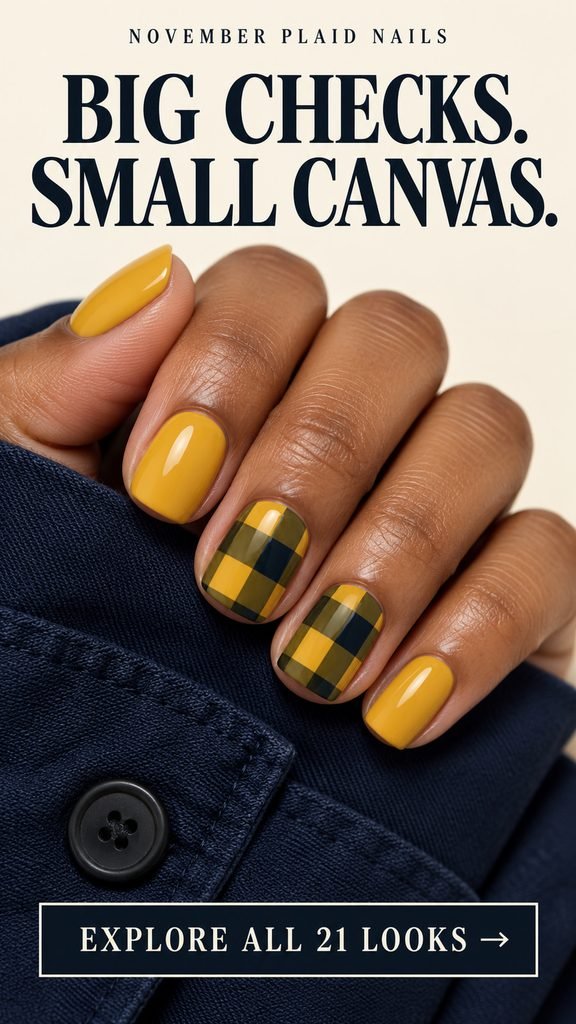
These mustard-and-ink checks have the easy boldness of an oversized checked shirt. The accents use a few substantial blocks, while plain mustard nails keep the color cheerful. Darker intersections give the pattern its layered look, even though the finished artwork is flat.
Scale is the main decision here. A large check only needs a few crossings to be recognizable on a short nail. If you add lots of thin lines, you will change the character of the design. Pick a muted mustard that you enjoy on its own, because the undecorated nails are a big part of this set.
Wear it with: A navy overshirt, a cream tee, and dark jeans; a small mustard accessory can echo the manicure.
Salon note: Muted mustard nails with two large ink-and-mustard check accents. Broad crossing bands, deeper intersections, and only a few clearly visible squares.November plaid nail idea 10 / 21
10. Forest Plaid with a Copper Thread
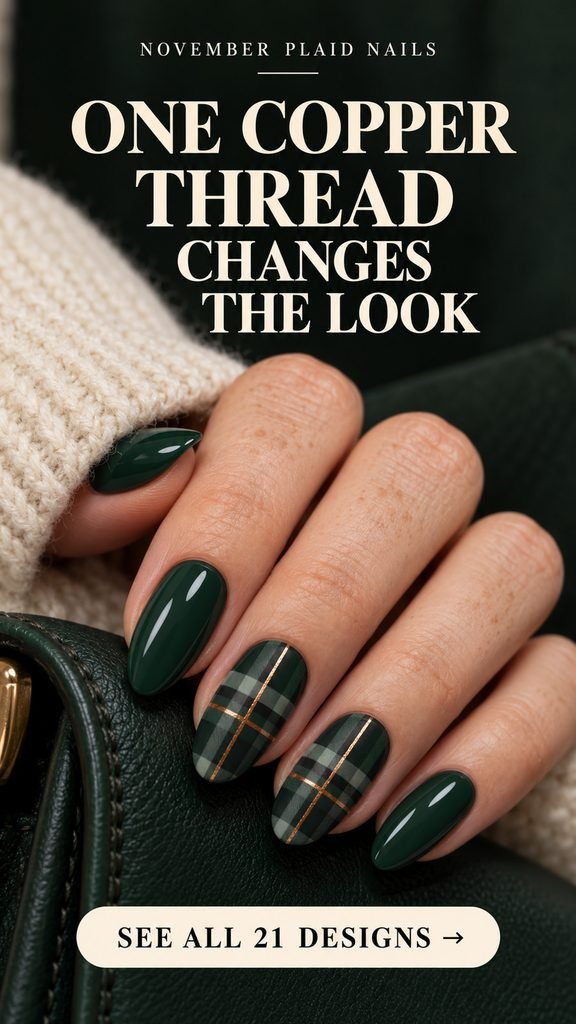
Forest plaid becomes a little dressier when a copper thread runs through it. Charcoal and sage provide the checks, and the metallic line adds a small glint without covering the whole nail in sparkle. Solid green on the other fingers gives the copper something quiet to stand beside.
The metallic stripe should be noticeably finer than the colored bands. That difference keeps it looking like a thread woven through the plaid. You can use just one direction of copper if a full crossing feels too bright. For your salon reference, point out that you want a painted metallic line rather than scattered foil pieces.
Wear it with: A forest-green bag with a cream knit and brown boots; warm metal jewelry can pick up the copper detail.
Salon note: Two forest-green plaid accents with charcoal and sage bands, crossed by a very fine copper line. Plain glossy forest green elsewhere; copper detail smooth and restrained.November plaid nail idea 11 / 21
11. Sheer Offset Plaid
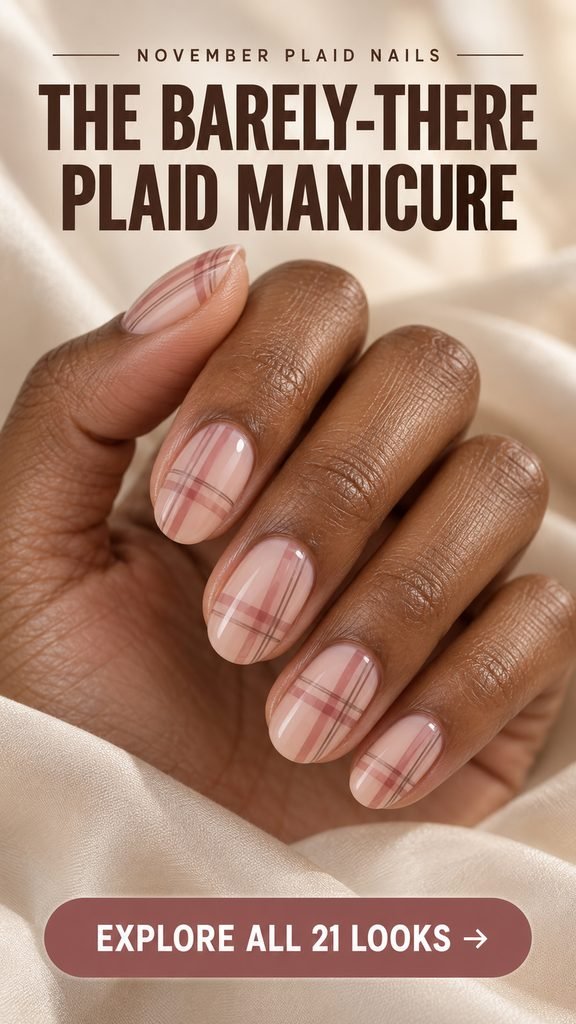
Sheer offset plaid is for the person who saves patterned manicures but still loves a nearly bare-looking base. Dusty-rose bands and thin taupe lines drift to one side, leaving space around the design. You notice the polish first, then the little crossings.
Transparency matters more than the exact number of stripes. Ask to see the base swatch before the plaid goes on; a fully opaque beige will create a heavier effect. Position the main crossing slightly away from the center, then balance the remaining lines around it. On a narrow nail, fewer bands will preserve the airy feeling.
Wear it with: Soft beige layers, a pale pink scarf, or a simple white shirt; this pattern stays subtle beside light colors.
Salon note: A sheer pink-beige base with sparse dusty-rose plaid bands and fine taupe lines, grouped slightly off-center. Plenty of clear-looking space and a glossy finish.November plaid nail idea 12 / 21
12. Diagonal Lilac-and-Grey Plaid
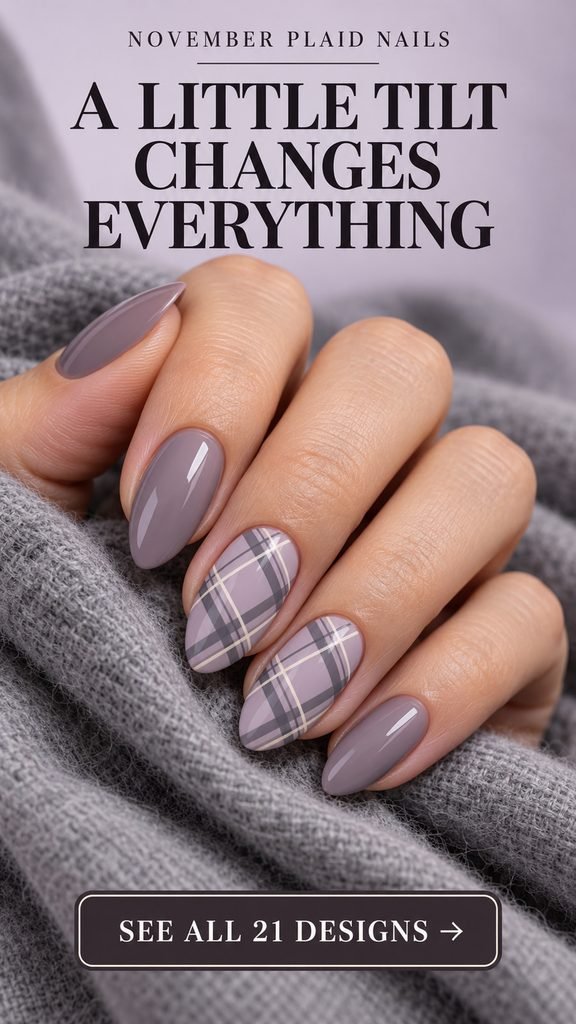
Tilting the plaid changes the movement of the entire manicure. Lilac, grey, and ivory stripes still cross in a regular pattern, but the diagonal direction creates open diamond-shaped spaces. Against the solid mauve-grey nails, the accents feel like a scarf folded on the bias.
Show your artist the direction as clearly as the colors. This look uses intersecting stripes; filling every diamond would create a different pattern. On a shorter nail, one broad diagonal band with a few fine crossings may be enough. The grid can continue beyond the edge, so there is no need to fit a complete diamond into every corner.
Wear it with: A grey scarf, a lilac knit, and charcoal outerwear; keep the larger clothing pieces plain to showcase the angled detail.
Salon note: Two pale-lilac accents with smoky-grey and ivory plaid tilted diagonally. Preserve the open spaces between crossing stripes and pair with glossy mauve-grey nails.November plaid nail idea 13 / 21
13. Half-Plaid Navy Nails
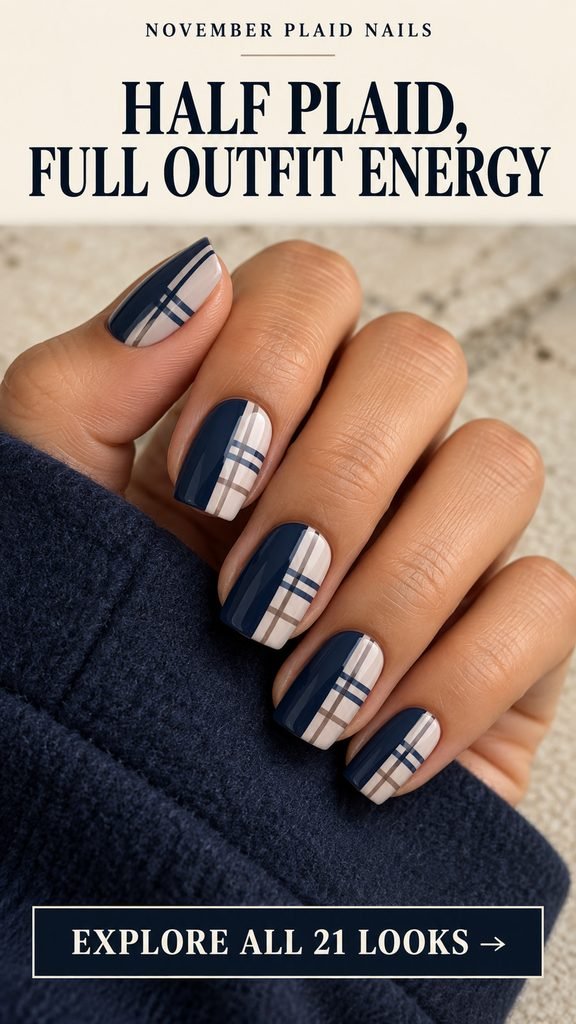
Half-plaid navy nails divide the surface like two pieces of an outfit: a solid coat on one side, a checked layer on the other. Oatmeal gives the fine navy and taupe stripes a light background, while the dark half makes the edge of the pattern look sharp.
Decide where the dividing line belongs on your own nails. An even split works well on a roomy shape, but a slightly wider plaid half can make the pattern clearer on a narrow one. There is no need for a metallic strip along the seam. The contrast between navy and oatmeal already defines the two areas.
Wear it with: A navy coat over a cream sweater, with dark trousers or jeans for a simple coordinated look.
Salon note: A lengthwise split between glossy navy and oatmeal plaid with fine navy-and-taupe lines. A clean seam, no added divider, and enough width for the pattern.November plaid nail idea 14 / 21
14. Fig Plaid Half-Moons
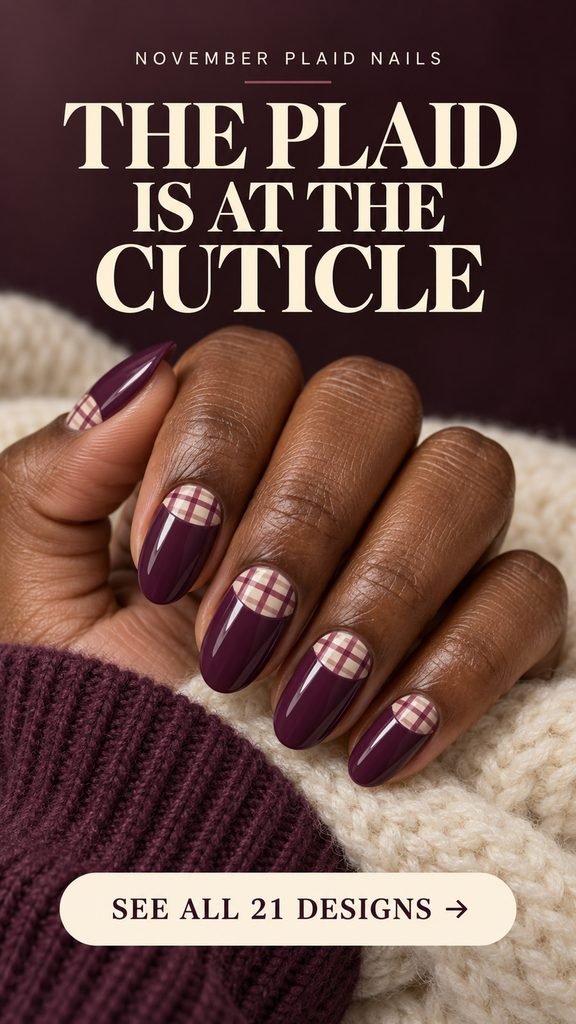
Putting the plaid near the cuticle gives a dark fig manicure an unexpected starting point. Cream half-moons hold small purple and rose checks, leaving most of the nail a deep, glossy solid. It has the feeling of a patterned lining that only shows in one small place.
This detail needs a slightly generous half-moon to remain readable. On a short nail, simplify the plaid to one or two fine crossings before making the cream area too tall. Ask your artist to check that the curved border feels balanced across the set. The pattern can vary a little within it, but the overall placement should feel consistent.
Wear it with: A fig or plum top under a pale coat, or a cream blouse with dark tailored trousers.
Salon note: Glossy fig-purple nails with cream half-moons near the cuticles, each holding a small fig-and-rose plaid. Pattern stays inside the curved cream area.November plaid nail idea 15 / 21
15. Ink Plaid with a Fine Red Thread
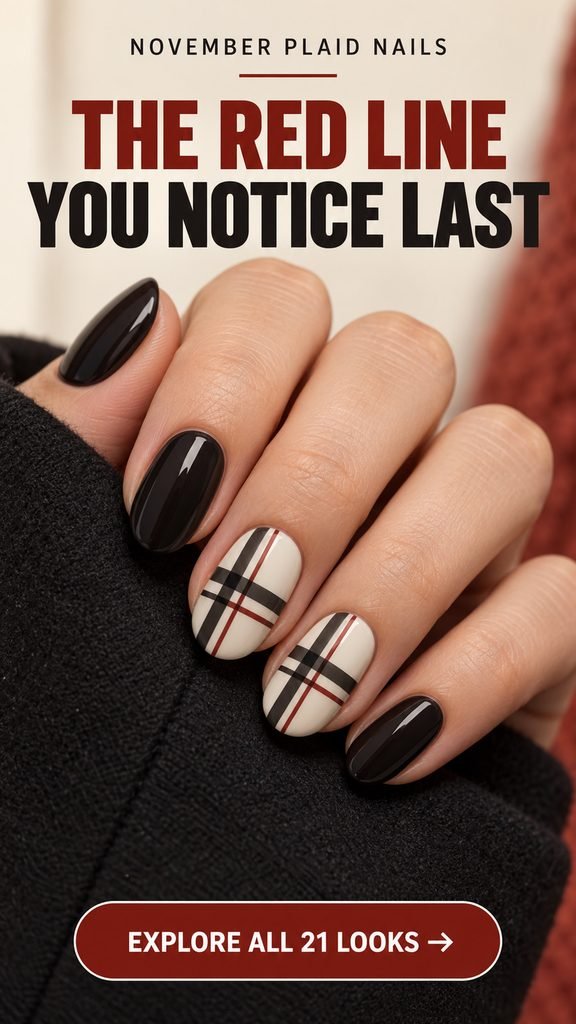
The first thing you notice is the contrast between ink and ivory. Then the tiny red thread appears. It is a useful way to add a warm color to an otherwise monochrome manicure without turning the whole set red. The solid dark nails make those two patterned accents feel crisp.
Choose a softened brick red if you want the restrained effect shown here. A bright scarlet will become a much stronger focal point. The red should remain finer than the dark bands, with enough ivory still visible between the crossings. For a very small nail, a single red line can give you the same little surprise.
Wear it with: A black jacket and ivory knit, with a brick-red lip, scarf, or bag if you want one small color echo.
Salon note: Two ivory plaid accents with near-black bands and a fine brick-red thread. Plain glossy ink nails elsewhere; preserve open ivory spaces and a delicate red detail.November plaid nail idea 16 / 21
16. Moss Plaid with a Tiny Bow
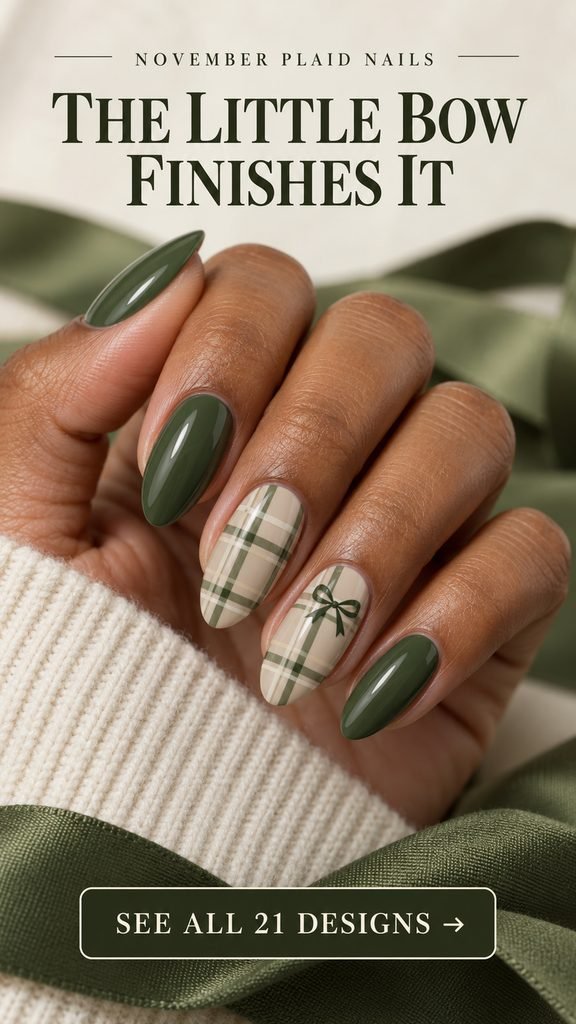
A tiny bow makes moss plaid feel like a complete outfit rather than just a print. The soft mushroom background gives the checks some breathing room, and the dark olive bow adds a small focal point on one accent. It is a playful detail, but the muted palette keeps it calm.
Let the bow occupy a clear area of the plaid instead of covering its busiest crossing. Small loops and short tails will stay readable on the nail. If you prefer a smooth surface, specify a painted bow when you book the design. A raised charm would change both the look and the feel of this reference.
Wear it with: A moss cardigan with a cream blouse; a small ribbon or soft collar detail can echo the bow without matching exactly.
Salon note: Mushroom-beige plaid accents with moss-and-cream lines, plus one tiny flat-painted dark olive bow. Glossy moss nails on the remaining fingers.November plaid nail idea 17 / 21
17. Patch-Pocket Plaid Accents
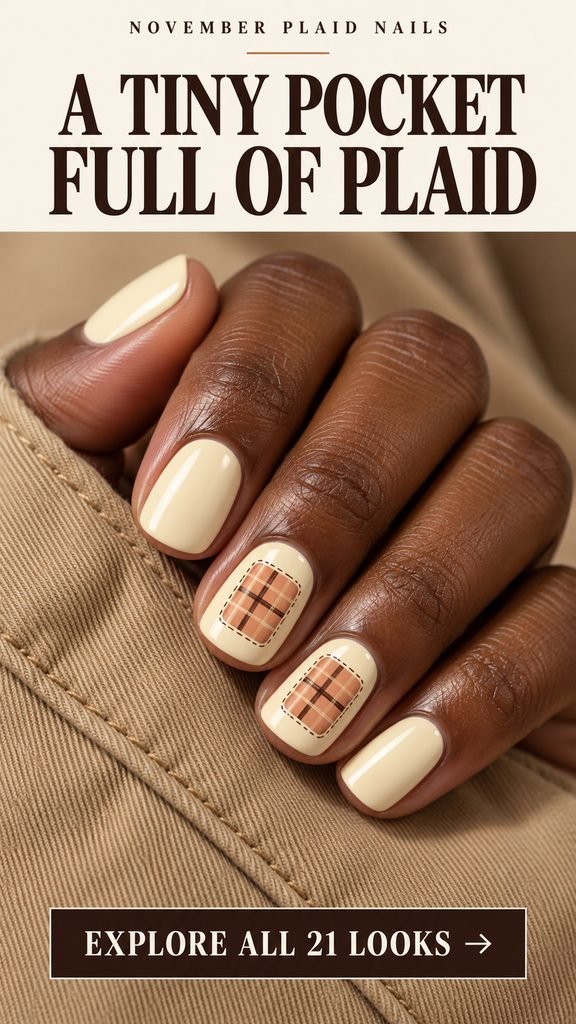
These little plaid patches borrow the outline of a jacket pocket. The apricot rectangles sit inside a buttercream manicure, with fine dashed marks suggesting stitching around their edges. Keeping the print contained in a small patch makes the idea feel playful and deliberately miniature.
Leave a visible border of plain buttercream around each patch. Without that space, the pocket shape will blend into a regular full-nail plaid. On short nails, enlarge the patch just enough to show its checks and reduce the number of faux stitches. Both the rectangle and the stitching can be painted flat; the effect does not depend on a raised piece.
Wear it with: A tan utility jacket, an ivory top, and relaxed denim; the tiny pocket detail suits simple practical layers.
Salon note: Buttercream nails with two small apricot plaid patch-pocket accents, outlined by fine cocoa dashed stitches. Keep the patches flat and clearly separate from the nail edges.November plaid nail idea 18 / 21
18. Teal Plaid with a Peach Overcheck
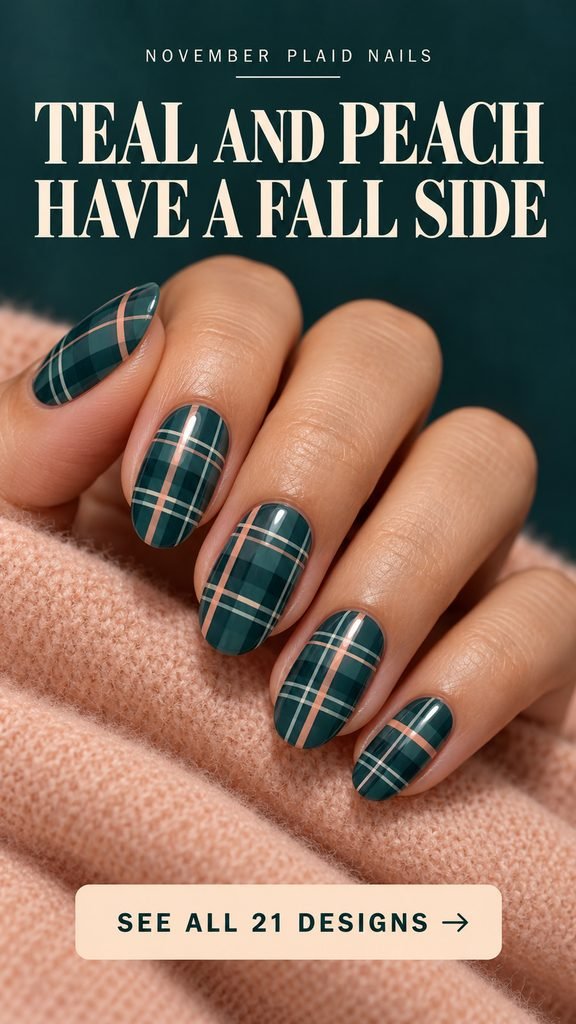
Teal and peach make a warmer pairing than you might expect. The deeper teal bands keep the manicure grounded, while fine peach lines brighten the crossings. The effect is closer to a colorful woven scarf than to a pastel spring manicure, especially when the base stays deep and slightly muted.
The peach works best as a narrow overcheck: a fine set of lines laid across the broader plaid. Too much peach would change the balance of the set. Ask to see the two shades beside each other before choosing the final combination. A dusty peach will feel softer; a brighter coral will make the contrast more energetic.
Wear it with: A teal knit or coat with a pale peach scarf, balanced by cream or dark denim underneath.
Salon note: Deep dusty-teal plaid with darker teal bands, thin peach overcheck lines, and sparse cream details. Keep teal dominant and the light lines crisp.November plaid nail idea 19 / 21
19. Mulberry Jelly Plaid
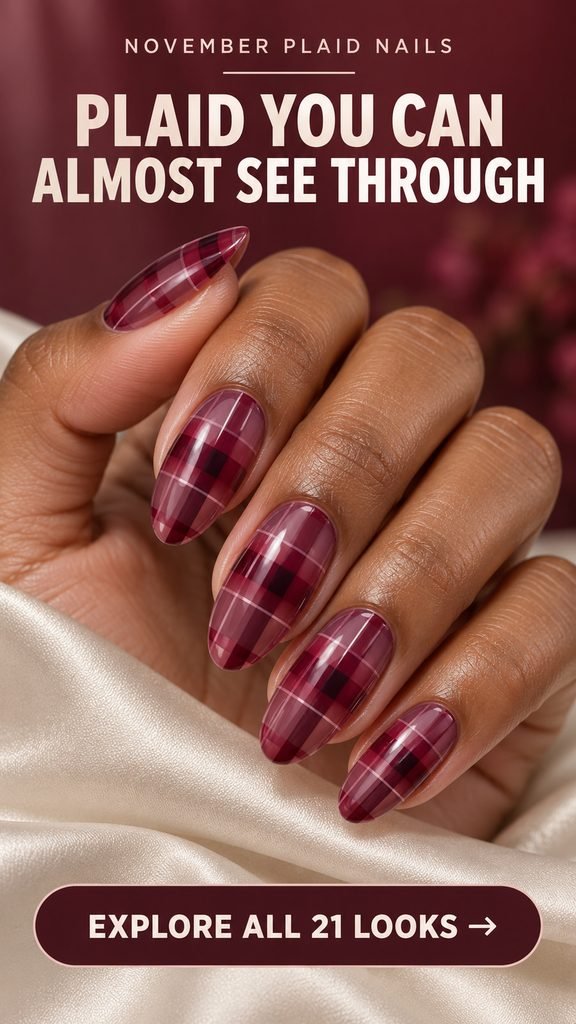
Mulberry jelly plaid lets the color stay luminous. Semi-transparent berry bands deepen where they cross, so the pattern seems to build from within the base. Fine pale-pink lines give it definition without taking away the glassy look.
Ask for a translucent sample before committing to the full set. A dark opaque mulberry would still make lovely plaid, but it would lose this particular lightness. The darkest intersections should remain distinct from the background. If the base starts to look too dense, reduce the number of overlapping bands rather than adding more pale lines to compensate.
Wear it with: A berry scarf with a cream sweater, or a charcoal outfit when you want the glossy color to be the accent.
Salon note: Translucent mulberry nails with deeper semi-transparent berry plaid bands and fine pale-pink lines. Glossy finish, distinct intersections, and visible light through the base.November plaid nail idea 20 / 21
20. Two-Scale Taupe Plaid
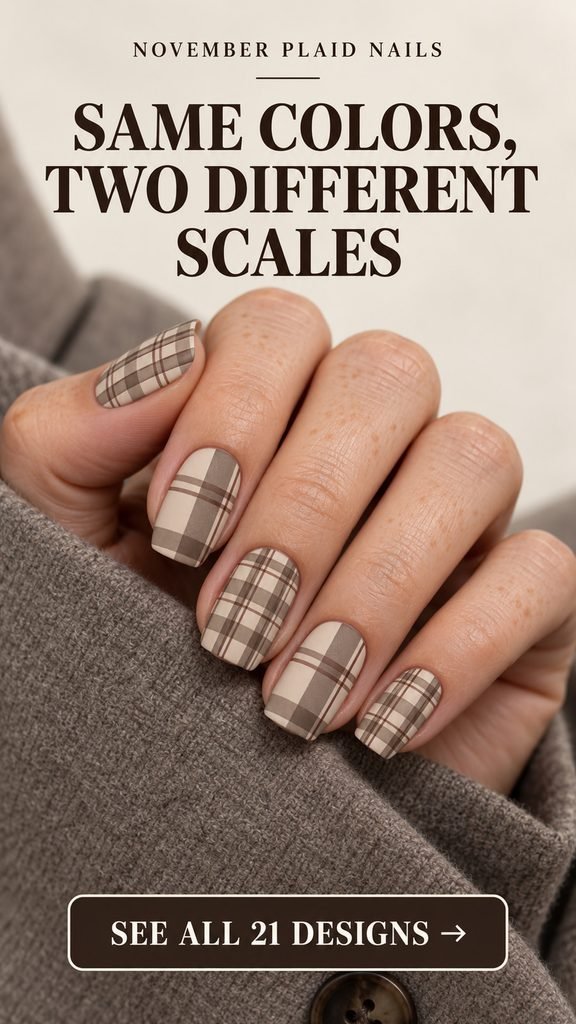
You can mix patterns without mixing colors. Here, taupe and cream stay consistent while the scale changes from one nail to the next. A larger plaid gives you room to notice the individual bands; the smaller repeat looks more like a fine check on tailored fabric.
Use the same stripe colors and order for both versions, then alter the spacing. That shared structure is what makes the set feel related. Decide which fingers will carry the larger pattern before the painting begins. On a short set, the smaller repeat should still have clear gaps; there is no benefit to making it so fine that it reads as a blur.
Wear it with: A mushroom-grey coat, cream layers, and tonal trousers; the mixed scales add interest to a quiet palette.
Salon note: Taupe-and-cream plaid in two scales: roomy checks on selected nails and a smaller repeat on the others. Keep the stripe colors and order consistent across the set.November plaid nail idea 21 / 21
21. The Mix-and-Match Plaid Capsule
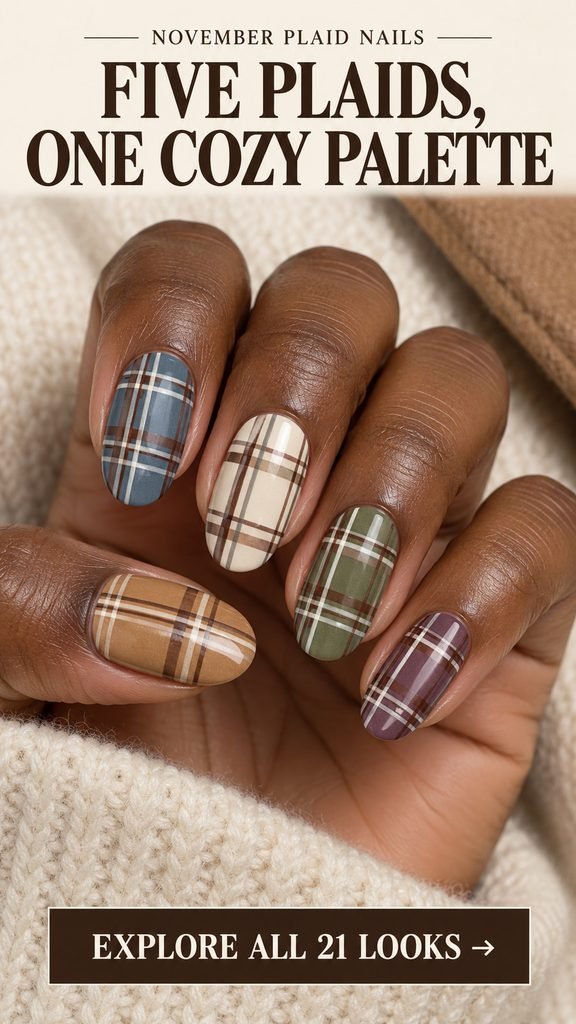
This is the little capsule wardrobe of the collection. Camel, denim blue, cream, olive, and plum each get their own nail, but the cocoa and ivory lines make them feel like they belong together. It has the pleasure of mixing favorite fall pieces without trying to make every color match.
Choose the two shared stripe colors first, then build the base palette around them. Keep the bases similarly muted so one nail does not suddenly become much brighter than the others. A smaller version can use three base colors repeated across the hand. The idea is variety held together by a recognizable thread, not a different visual rule on every finger.
Wear it with: An outfit built from any two colors in the set; plain layers give the mixed plaid room to show.
Salon note: A muted mix of camel, denim blue, cream, olive, and plum plaid nails. Use the same cocoa-and-ivory stripe colors throughout, with modest changes in spacing.
Build Your Plaid Palette from an Outfit You Already Love
You do not need to find a perfectly matching plaid shirt. Start with a combination you already wear: perhaps a navy coat, an oatmeal sweater, and brown boots. Navy can become the main nail color, oatmeal the broad band, and brown the fine line. The proportions can change, but the familiar colors make the manicure feel connected to your wardrobe.
If your clothes already carry a strong print, choose a smaller amount of nail art: one accent, a side panel, or patterned tips. If your usual outfit is mostly plain, a full plaid set can supply the detail. Treat the pairing suggestions above as starting points, then use what is already in your closet.
When you send a reference to your nail artist, include the number of patterned nails and your intended length. Ask for the quote to reflect that exact layout. It is also useful to say which feature you care about most: the transparent base, the large checks, the fine metallic line, or the tiny bow. That makes any necessary simplification much easier to discuss.
Questions That Help You Choose Your Plaid Manicure
Which of these looks is a good starting point for short nails?
Olive-and-ecru gingham and mustard-and-ink checks show how a few clear blocks can fill a short shape. Denim-blue shirt plaid uses a lighter network of lines. Choose based on the amount of contrast you want, then reduce the number of repeats if the pattern looks crowded at your nail size.
Does plaid have to be hand-painted?
No. Hand painting is one route, and a suitable stamping design or predesigned press-on can be another. OPI’s Plaid Behavior set is an example of ready-made plaid nail art. For a custom version of a design here, ask your artist which method will best preserve the scale and placement you like; a fixed printed pattern may offer less flexibility.
How do I keep the colors from smearing when I add top coat?
With air-dry nail art, follow your polish and top-coat instructions and try the combination on a practice tip before finishing the whole set. Choose a finish intended to work over the artwork you are using. For example, Maniology’s Smudge Free Top Coat instructions call for an additional protective top-coat layer over that specific formula. Different systems can require different finishing steps.
Should I choose glossy or matte plaid?
Glossy plaid has a clean, polished look, especially on a sheer or jelly base. Matte plaid can suggest the softness of suiting or a scarf. The grey blazer and plum scarf designs are useful matte references; mulberry jelly depends on its glassy shine. Compare a finished sample if you are undecided, since the finish changes how the colors read.
Will the manicure clash with patterned clothes?
It can be easier to coordinate when one color repeats across both. You can also change the scale: a small nail check beside a larger scarf plaid, or a single patterned nail beside a busy shirt. If you prefer a quieter combination, keep the clothing plain and let the manicure be the patterned accessory.
Save the plaid that reminds you of something you already love wearing. A familiar palette and one well-chosen detail can make the whole manicure feel like yours.