
If you are a first-generation college student, start by finding one person on campus who can help you navigate the system. Then put your deadlines in one place and ask someone to walk through your financial aid offer with you. Those three moves give you a place to turn when the next unfamiliar form, bill, or course requirement shows up.
First-gen commonly means neither parent completed a bachelor’s degree, although each college or program may define it differently. You do not need to arrive knowing what a registrar does or how to talk to a professor. These 15 things make the practical side of college easier, whether you live in a dorm, commute, work, or are returning to school.

The visuals are AI-generated concepts illustrating student situations, not photographs of real students or campus services.
1. Find Your First-Gen Starting Point
Search your college website for “first-generation students,” “student success,” and “TRIO Student Support Services.” Look for an actual contact person, an application, and the next opportunity to meet. A first-gen center can be a useful starting point even when you are unsure what help you need.

Ask: “I’m a first-generation student. What support can I use, and do I need to apply?” Follow up about peer mentoring, advising, tutoring, and any welcome or bridge programs. Availability varies; a program’s name does not tell you all its eligibility rules.
TRIO Student Support Services has participation requirements, so being first-gen does not automatically enroll you. If you do not qualify or there is a waitlist, ask which general campus services you can use now.
2. Save a Small List of People Who Handle Different Problems
“Ask the college” is frustrating advice when the college has dozens of offices. Make a phone note with the name, email, location, and appointment link for these starting points:
- Academic advising: course choices, degree requirements, and planning your next term.
- Financial aid: aid offers, required documents, eligibility, and renewal questions.
- Student accounts or bursar: your bill, payments, and account balances.
- Registrar: registration records, transcripts, and enrollment procedures.
- Dean of students or student support: help finding the right office when a personal problem affects school.
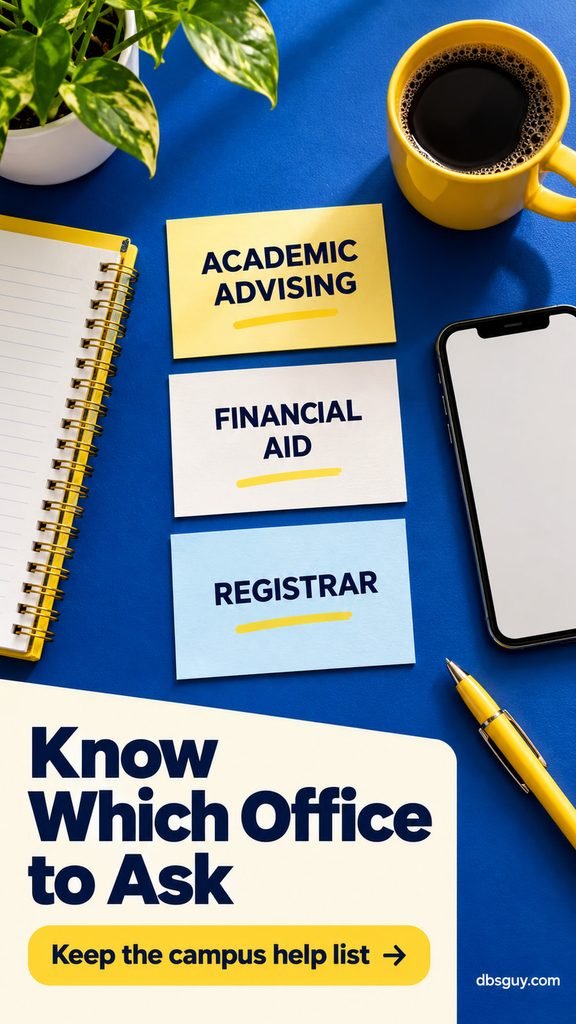
Office names and responsibilities vary. If you reach the wrong person, ask: “Which office owns this, and could you give me a direct contact?” Save the answer. You are building a useful directory, not memorizing the whole institution.
3. Turn Each Syllabus Into a Plan You Can Actually Follow
A syllabus is the course’s instruction sheet. Read it alongside the learning management system, or LMS—the online place where your class posts materials, assignments, and grades.

For each class, pull out the big assignments, exams, attendance rules, grading breakdown, required materials, and the instructor’s contact method. Put due dates and submission times in one calendar. Check the time zone for online courses.
Then add a starting appointment. “Read the essay prompt Tuesday after lunch” gives you something to do before “essay due Friday.” Check course announcements for changes; a calendar entry is only useful if you update it.
Also find the rules for collaboration, citations, and AI tools. If a policy is unclear, ask before using a tool or sharing work with a classmate.
Also Read: Freshman Year: The Complete Survival Guide
4. Use Office Hours With One Specific Question
Office hours are times when an instructor or teaching assistant is available to talk with students. You can ask about a confusing concept, an assignment, or feedback. You do not need to be failing to go.

Check whether you should drop in, book an appointment, or join an online meeting. Bring the relevant work and show where your understanding stops.
Try this: “I compared the two readings, but I can’t tell whether my paragraph explains the difference clearly. Could we look at this part?” That is easier to answer than “I don’t understand anything.”
If the posted hours overlap with your job, write: “I’m in your afternoon section and work during office hours. Is there another time or an online option for a short question about the assignment?”
5. Ask an Advisor Which Classes Move You Toward Your Degree
A class can sound interesting and still fill none of your remaining requirements. Before registration, open your degree audit—the record showing requirements completed and still needed—and take it to your advisor.

Bring these questions:
- Which requirement does each proposed class satisfy?
- Is there a prerequisite I need before a later course?
- Is a required class offered only in certain terms?
- What is a useful backup if my first choice fills?
- If I plan to transfer, who can confirm how these credits apply at the destination school?
Ask how placement results, previous college credit, or a major change affect the plan. Save the written summary and check it against your official program requirements. When advice conflicts, ask the department or advising office to resolve it before you register.
6. Have Someone Explain Your Aid Offer Line by Line
An aid offer and a tuition bill answer different questions. The offer lists assistance; the bill shows charges and the balance on your student account. Put both in front of you when you meet with financial aid.

Separate the offer into three categories:
- Grants and scholarships: generally do not need repayment, but have conditions. Ask what could require repayment or affect renewal.
- Work-study: an opportunity to earn money through a qualifying job. An award does not automatically give you a job or an upfront tuition payment.
- Loans: borrowed money with repayment obligations. Ask about the terms before accepting.
Federal Student Aid’s guide to evaluating aid offers explains why you need to compare both costs and types of aid. For your own offer, ask: “What is still pending, what must I do next, and what balance will remain when?”
Confirm which academic year your FAFSA covers, the deadlines that apply to you, and what you must do to renew aid. If your family’s finances have changed, ask the office about its review process rather than assuming the original offer is final.
7. Plan for the Costs That Do Not Appear on the Tuition Bill
Books, course access codes, laundry, parking, transit, groceries, and travel home can make an affordable-looking week difficult. Start with your actual class materials list and travel needs, not someone else’s dorm shopping haul.

Write down confirmed money coming in and essential costs through your next reliable payment. Set aside money for bills due during that period, then divide the remainder across the weeks it must cover. If the result does not cover basics, take that gap to student support or financial aid; a tighter shopping list cannot solve every shortfall.
Do not count a work-study award as cash available today. Ask when the first paycheck would arrive. Before buying textbooks, check library reserves, used or rental options, and whether the course requires a new access code that a used book will not include.
8. Bring One Stuck Problem to Tutoring Early
You can use tutoring before a low grade arrives. Look for subject tutoring, writing support, a learning center, or supplemental instruction. Check availability, booking rules, and whether the service has a fee.

Bring the assignment directions, your attempt, and one clear request: “Can we work out why I keep choosing the wrong formula?” For a paper, bring the prompt and a rough paragraph; ask for help with structure or reasoning rather than expecting someone to rewrite it.
Between appointments, make yourself produce an answer. Close the notes, try a course practice question or explain a concept aloud, then check what you missed. UNC’s Learning Center recommends active practice spread across sessions. Use the next tutoring visit to address the gap you found.
9. Build Your Schedule Around Work, Travel, and Caregiving
A gap between classes is not automatically free time. You may need it to get across campus, eat, work, pick up a child, or catch the last bus home.

Put fixed commitments in your calendar first: classes and labs, shifts, travel, caregiving, and the time you need for sleep. Fit study appointments into what remains. Name the task—“chemistry practice questions”—so you can begin when the time comes.
If the schedule has no workable study space, ask an advisor about course sections and workload before the relevant deadlines. Ask your employer how far ahead you can request exam-week changes. There is no single work-hour target that fits every student’s bills and responsibilities.
For a long campus day, locate a place to eat, charge your phone, and study between commitments. Those details matter more than a perfect-looking planner.
10. Choose One Place Where You Can Become a Familiar Face
You do not have to join five clubs to find community. Pick one recurring setting that fits your interests and schedule: a first-gen group, a major-related club, a study session, or a campus job.

Give a welcoming group another visit. At the next meeting, ask one person a small, specific question: “Have you taken this lab?” or “Are you coming to next week’s session?” Familiarity gives the conversation somewhere to start.
If you commute, choose something on a day you are already on campus. If you study online, look for a recurring virtual group. You can decline expensive outings and still take part. Try suggesting lunch after class or a free campus event instead.
Also Read: How to Join Clubs in College: Find Your People Freshman Year
11. Explain to Your Family What College Time Looks Like
Your family may care deeply about your education without knowing why two hours of class can lead to an afternoon of reading, lab work, or writing. Show them a real week instead of asking them to understand an abstract workload.

A conversation starter: “I’m in class Monday and Wednesday mornings, and I need Tuesday afternoon for assignments. I can help with errands Thursday after four. During exam week, can we plan differently?”
Keep the request realistic. If your family depends on your income, transportation, translation, or caregiving, name the specific conflict and talk through what can change. A boundary may need a backup plan, not just a firmer sentence.
Decide how you want to share updates, too. A scheduled call can leave room for connection without making every study break a check-in. You can value your family and ask for protected time.
12. Ask About Basic-Needs Help Before the Situation Gets Worse
If food, housing, transportation, or access to a computer is making school harder, search your college website for “basic needs” or contact student support. Ask what is available rather than trying to guess whether your situation is serious enough.

Possible services include a food pantry, emergency funding, technology loans, meal assistance, or community referrals. These are options to ask about, not benefits every campus guarantees.
You can say: “I’m having trouble covering groceries and transportation this month. What can I apply for, what documents do I need, and how soon might help be available?” Ask whether assistance has conditions or affects other support you receive.
If the first option does not fit, request another referral. Keep a record of the application and follow-up date so an unanswered email does not become the end of the process.
13. Learn How to Arrange Accessibility and Personal Support
There are different routes for different needs. The accessibility or disability-services office handles accommodation requests; a counseling center handles mental health support. Student support can help you identify a starting point if you are unsure.

If a disability or ongoing condition affects your coursework, ask accessibility staff about the request process, documentation, timing, and how approved arrangements reach instructors. Contact them even if you had support in high school; get the college’s instructions for its own process.
For counseling, ask how to schedule, what it costs, what privacy rules apply, and what happens if appointments are full. You can ask about support for homesickness, family pressure, or academic stress without deciding on a diagnosis yourself.
Neither office requires you to arrive with polished language. “This is affecting my ability to attend or complete work; what is my next step?” is a useful opening.
14. Take the Experience You Already Have to Career Services
You can visit career services before you know your ideal job. Bring a rough list of paid work, caregiving, volunteering, class projects, and responsibilities you have handled. Ask which examples belong on a resume and how to describe them accurately.

For example, a retail job might give you real experience explaining products, handling transactions, or training a coworker. Use only duties you actually performed. You do not need to rename ordinary work to make it worth discussing.
Ask how your campus advertises student jobs and internships, when applications open, and whether there are paid opportunities in your area of interest. Have a career advisor review an offer’s pay, hours, location, and any credit requirements with you.
Before applying, request feedback on one resume and one sample application. That gives you a starting version to improve instead of a blank page each time.
15. Treat a Setback as a Problem With a Next Step
A missed assignment, low exam score, or account hold needs a response. It does not need to become a verdict on whether a first-generation student belongs in college.

Use this recovery checklist:
- Check the facts. Read the feedback, syllabus rule, or official notice. Find the deadline and what action is required.
- Contact the person who can act. Ask the instructor about the assignment, the advisor about course options, or the relevant office about the hold.
- Choose one next action. Book tutoring, submit an allowed correction, provide a missing document, or arrange a planning meeting.
- Confirm what happens next. Save the reply and add any follow-up deadline to your calendar.
Before dropping a class or leaving school, ask advising, financial aid, and student accounts about academic, aid, and billing consequences. Deadlines and outcomes vary. Ask about your school’s satisfactory academic progress requirements—the standards used to determine continued aid eligibility—and any review or appeal process that may apply.
Questions First-Generation Students Often Ask
Am I first-gen if my parent attended college but did not graduate?
Often, yes. A common definition is that neither parent completed a bachelor’s degree. Definitions vary by institution and program, including how they treat family circumstances and degrees earned outside the United States. Ask the program to check your situation. An older sibling’s degree does not, by itself, rule you out under the common parent-based definition.
Does being first-gen automatically mean I qualify for a scholarship?
No. First-gen status may be one eligibility factor, but each scholarship has its own requirements and application process. Ask financial aid and the first-gen office about opportunities, deadlines, and renewal conditions. First-generation and low-income describe different things; do not assume one automatically establishes the other.
What should I say if I do not know which question to ask?
Start with what is happening: “My portal says I have a hold, and I don’t know what it means,” or “I received an aid offer, but I cannot tell what I would owe.” Ask the staff member to explain the next action and who handles it. You do not need the right campus vocabulary before asking for help.
What is the most useful thing to do today?
Save one real campus contact, put your nearest deadline in your calendar, and send one question you have been postponing. Leave yourself a note with the next step and when to follow up. That is enough for a useful start.