
For a lively gift swap, choose White Elephant. For a personal present, choose Secret Santa. For a quick game with very little preparation, choose a dice exchange. The best fit depends on whether your guests enjoy trading, guessing, performing, or simply opening something together.
These 21 gift exchange games include complete house rules, clear stopping points, and ways to keep everyone included. Except for Secret Santa, each game uses a shared pool of gifts rather than presents bought for named recipients. Choose one game for your exchange; you do not need to play the whole list.

Choose a Game for Your Group
- Friends who enjoy playful competition: White Elephant (1), the play-money auction (11), or rock-paper-scissors trading (20).
- Office parties or quieter groups: Secret Santa (2), ribbon pull (12), or mystery-clue draft (17).
- Simple, seated family fun: one-die swap (3), left-right story (5), or musical gifts (6).
- Kids who need a definite turn: gift hot potato (7), pass the parcel (14), or mitten unwrap (16), with an adult helping.
- A little more activity: charades (9), a gift hunt (13), or wrapping relay (15).
The player counts and times below are planning estimates for the versions described, not tested guarantees. Passing games work best with lightweight presents; use numbered envelopes representing bulky or fragile gifts.
Set These Gift Exchange Rules Before Anyone Shops
Send the invitation two to four weeks ahead if people need to buy or make a gift; allow more time for a mailed Secret Santa. That is a planning suggestion, not a deadline everyone must follow. Include the date, location, game, wrapping instructions, and spending cap in the first message.
- Make the budget comfortable. A $15, $20, or $25 cap can work if the group agrees. State whether tax and shipping count. Spending more should not earn an advantage.
- Define the gift pool. Useful gifts, funny gifts, handmade gifts, and regifts create different expectations. Choose a lane, or explicitly allow a mix.
- Count participants and presents. Bring one main gift per player and keep one or two backup gifts. The host needs a gift too if playing.
- Make participation optional. Let people watch, and offer a helper for reading, reaching, wrapping, or passing. For kids, use gifts suited to the same age group.
- Say whether your own gift can come back. For these shared-pool games, it can. Afterward, two willing people may trade privately.
For an office pool, avoid personal jokes that depend on embarrassing someone. If food is allowed, ask about dietary restrictions and keep ingredient information with the gift. For affordable shopping ideas, see 35 Budget-Friendly Christmas Gift Ideas for Coworkers Under $25.
The images below are AI-generated concept illustrations of party setups, not photographs of hosted or tested events.
1. Classic White Elephant
Best for: 6–16 players who enjoy stealing gifts. Allow: about 25–45 minutes. Bring: one wrapped gift per person, numbered slips, and a way to mark frozen gifts.
White Elephant, Dirty Santa, and Yankee Swap often name the same general choose-or-steal game. Groups use different limits; the White Elephant Rules guide describes several options. Here is one bounded house version to announce before play:
- Draw numbers. Player 1 opens a gift from the pile.
- Each next player opens a new gift or takes an eligible opened gift. A player left empty-handed does the same.
- During each numbered turn, a particular gift may be stolen only once. After the third steal in that turn, the empty-handed player must open a new gift.
- A gift freezes after its third theft across the whole game. Opening it initially does not count as a theft.
- After the last numbered turn, Player 1 keeps a frozen gift. Otherwise, they may keep their gift or make one final direct swap with an unfrozen gift. That swap ends the game; no replacement chain follows.
Mark thefts with removable dots. The per-turn limit and the whole-game freeze are separate counts.

2. Secret Santa With a Clue Reveal
Best for: 4–30 people who would rather give personally than compete. Allow: 1–2 minutes per reveal, plus shopping time beforehand.
Each person buys for one assigned recipient and receives one gift. Collect three interests or wish-list suggestions per person, then set a shared budget and exchange date.
Use a name-drawing service with self-matches excluded, or have a host shuffle the full recipient list against the full giver list and check every pairing. If anyone matches themselves, reshuffle the entire recipient list. With household exclusions, check those too. Do not leave the last person stuck drawing their own name.
Label gifts with the recipient’s name only. Add two friendly clues about the giver, such as “We both take the early train” or “You borrowed my muffin tin.” The recipient opens the gift, reads the clues, and gets one optional guess before the giver reveals themselves. No stealing; the named recipient keeps the gift.
A mailed exchange can use the same reveal on a video call. Confirm delivery before scheduling it. For shopping inspiration, browse 35 Genius Secret Santa Gift Ideas Under $25 on Amazon; check current prices against your cap.

3. One-Die Pass-and-Swap Game
Best for: 4–16 players. Allow: 10–20 minutes. You need one six-sided die and one wrapped gift per person.
Seat everyone in a circle with one randomly distributed gift each. Start with a randomly chosen player and take turns clockwise. On every roll, complete exactly one action:
- 1: Everyone passes their gift one seat left.
- 2: Everyone passes their gift one seat right.
- 3: The roller swaps gifts with the person on their left.
- 4: The roller swaps gifts with the person on their right.
- 5: The roller swaps with any other player.
- 6: The roller keeps their gift for this turn.
Play exactly three circuits, so everyone rolls three times. Gifts stay wrapped and remain available for every action, including after a 6. After the last roll of circuit three, everyone opens and keeps the gift they hold. “Keep” does not freeze a gift.

4. Two-Dice Doubles Trade
Best for: 4–14 players who want fewer passing instructions. Allow: 10–15 minutes. Use two dice and one gift per player.
Randomly distribute the wrapped gifts, then have everyone unwrap before play. Starting with a random player, give each person one roll of both dice per circuit.
- Doubles: Choose one other person and directly exchange gifts.
- Any other result: Keep your gift and pass the dice.
Play two complete circuits and stop after the final person’s second roll. No extra roll for doubles, no gift freezing, and no chain of replacement turns. Everyone still holds exactly one gift after a trade.
Unlike the one-die game, gifts are visible and only doubles trigger a move. Announce that distinction so guests do not carry over rules from the previous example.

5. Left-Right Christmas Story
Best for: 5–20 players and a confident reader. Allow: 5–10 minutes. Everyone starts seated with one randomly distributed, wrapped gift.
Read the original mini-story below slowly. On each bold LEFT or RIGHT, everyone passes their current gift one seat in that direction, using their own left and right. Pause until every person holds one gift before the next cue. The reader can play if someone helps with their passing.
“On Christmas Eve, Nora set the cocoa to her LEFT. Ben put the cookies on the RIGHT. The ribbon box was on the LEFT, but the scissors were on the RIGHT. Nora looked RIGHT toward the doorway. Ben looked LEFT toward the tree. They moved the empty basket to the LEFT and placed the last present on the RIGHT. Then a tiny bell rang on the RIGHT. Everyone turned RIGHT. Ben checked the shelf on the LEFT. Nora spotted a note on the RIGHT. It said, ‘Your surprise is waiting on the RIGHT.’”
Stop when the story ends. Open what you hold; do not add a last-minute swap. The story moves each gift three seats right overall, so it does not simply return every gift to its starting seat for the suggested group sizes.

6. Musical Gifts With No Elimination
Best for: 4–12 players, including families who want everyone involved throughout. Allow: 5–10 minutes. Gather lightweight wrapped gifts and a speaker.
Everyone starts with one gift. While the music plays, pass gifts clockwise at a steady pace, receiving one before passing the next. When the host pauses the music, everyone holds their current gift. Nobody opens it or leaves the game.
Resume and pause the music five times in total. Announce the count after each stop. At stop five, the gifts become final and everyone unwraps together. For a predictable finish, choose the five music intervals before starting; roughly 20–40 seconds each is plenty.
For heavy gifts, pass the numbered tags instead. The surprise comes from the final stop, not from making people catch or rush.

7. Gift Hot Potato
Best for: 4–15 players who like a turn in the spotlight. Allow: 10–15 minutes. Use one soft or shatterproof ornament, music, and a central pile of wrapped gifts.
Pass just the ornament while music plays. When it stops, the holder chooses one gift from the pile and leaves the passing circle with it. That person has finished successfully; their gift cannot be taken.
Restart with the remaining players and repeat. The final player takes the last gift without another music round. Each person receives exactly one present, and everyone can open together afterward.
Have a nonplaying host control the music without watching the passing. For a seated group that cannot move closer as people finish, let a helper carry the ornament between active players.

8. Gift-Claim Bingo
Best for: 6–24 players and guests who prefer a table game. Allow: 15–25 minutes. You need paper, pencils, 30 numbered slips, and one gift per person.
Have each player draw a 3-by-3 grid and write nine different numbers from 1 to 30, in any arrangement. No free square. The host shuffles slips numbered 1–30 and draws without replacement.
A complete row, column, or diagonal earns one gift choice from the pile. Confirm the winning line, then retire that player’s card; they cannot claim again. Keep drawing until every player has claimed, or hand the last remaining gift to the final player.
For simultaneous bingos, use clockwise seat order starting from a randomly chosen seat announced before the first draw. Do not reset everyone’s cards after each winner. Every number will eventually be called, so a quiet player cannot be permanently locked out.

9. Christmas Charades Gift Pick
Best for: 4–14 people who enjoy performing. Allow: 15–20 minutes. Write one prompt per player on folded slips; repeats are fine for a bigger group.
Use actions that are easy to act without speaking: wrapping a gift, untangling lights, building a snowman, hanging a stocking, decorating a tree, carrying too many shopping bags, baking cookies, or putting on snow boots.
Draw a random turn order. Each player gets 30 seconds to act their prompt while everyone else guesses. Then the actor chooses one wrapped gift, whether or not anyone guessed correctly. The guess is the entertainment, not a condition for getting a present.
Continue until everyone has acted and chosen once. Open together at the end. A player may ask a partner to act or describe their prompt instead; keep the gift choice the same.

10. How-Well-Do-You-Know-the-Host Trivia
Best for: 5–20 friends or relatives. Allow: 10–20 minutes. Use answer sheets and six questions whose answers the host records before the party.
Ask: Which warm drink would I choose? What is my favorite holiday movie? Which cookie do I reach for first? Do I wrap gifts early or late? Which decoration do I put up first? What was the first holiday meal I learned to make?
Before each question, read three answer choices, with one matching the host’s recorded answer. Give everyone time to write A, B, or C. Read all six answers after the quiz and award one point per correct choice.
Highest score picks a wrapped gift first, followed by the remaining scores. Break ties by drawing numbered slips, not by adding an endless sudden-death round. Everyone selects one gift, including those with zero points. Keep private or potentially embarrassing topics out of the quiz.

11. Play-Money Gift Auction
Best for: 6–16 guests who enjoy bidding. Allow: 20–30 minutes. Make equal sets of play money worth 100 points per person; no real money changes hands.
Keep gifts wrapped and auction them one at a time. Start each at 5 points, with bids rising in 5-point increments up to 100. Once someone wins a gift, they pay the bid to the host and stop bidding for the rest of the game. Each person may win only once.
For simultaneous bids at the same amount, the host randomly draws among those bidders. If nobody bids on a gift, randomly award it to one of the remaining players for zero points. When one player and one gift remain, pair them automatically.
The funny tension is deciding which package deserves your single purchase. Leftover points have no cash value and earn no extra gift. Do not quietly introduce a premium “grand prize” that breaks the shared gift budget.

12. Ribbon-Pull Gift Match
Best for: 4–20 players and a quick, quiet exchange. Allow: 5–10 minutes. Prepare identical opaque envelopes, numbered cards, and equal lengths of ribbon.
Number every gift. Put one matching number in each envelope and attach a ribbon securely to the envelope. Mix the envelopes in a large box, keeping them concealed while their ribbon ends hang over the edge.
Each guest chooses one ribbon, pulls out its envelope, and takes the gift with that number. Remove the chosen ribbon and envelope immediately so nobody draws them twice. Once everyone has one, open together.
Use the ribbons to pull light envelopes rather than full gift boxes. It keeps heavy presents on the table and makes a large package no easier to identify by touch.

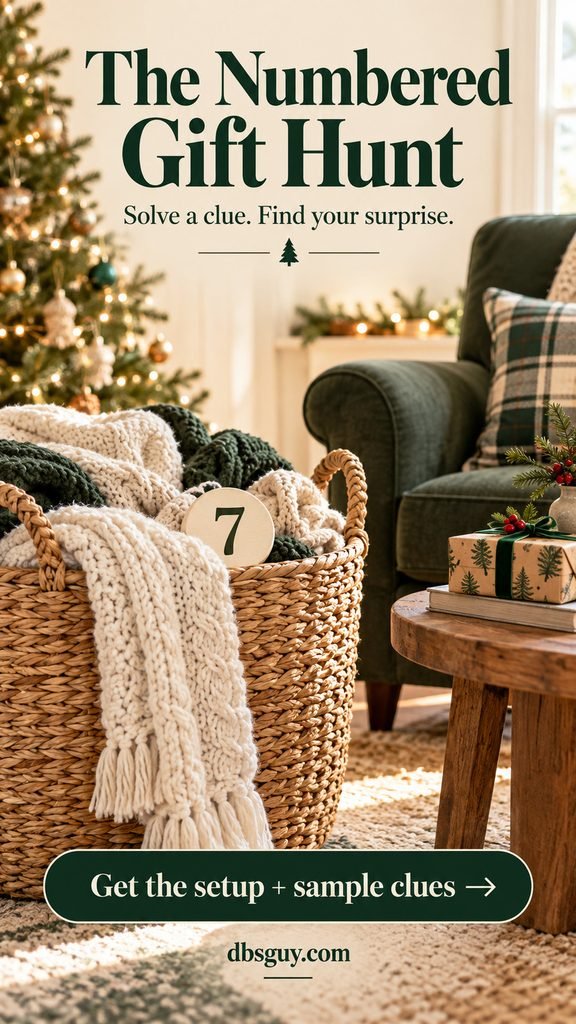
13. Numbered Gift Hunt
Best for: 4–12 players in a home with room to move. Allow: 10–20 minutes. Gather numbered gifts, matching tokens, and clue cards.
Hide one numbered token per player in an accessible location; leave the gifts on a central table. Make a short clue to each hiding place, then shuffle and hand out one clue per person. Guests find only their assigned token and exchange it for the gift with the same number.
Example clues: “Your number is where clean towels wait,” “Look beside the board games,” or “Check the basket that holds the blankets.” Choose spots guests can reach without climbing or opening private storage.
After five minutes, offer a direct hint. At ten minutes, reveal any unfound locations and distribute those gifts. Someone who prefers to stay seated can solve a clue aloud while a helper retrieves the token.
14. Pass the Parcel With a Gift Token in Every Layer
Best for: 4–12 players. Allow: 10–20 minutes. Prepare a soft parcel with one easy-open paper layer per player and a gift-number token inside each layer.
Number the gifts and prepare one token for each. Build the parcel around an empty small box, placing a different token between each successive layer. Use a small amount of tape so layers separate easily.
Pass the parcel while music plays. At each stop, the holder removes exactly one layer, takes its token, and claims the matching gift. That person leaves the passing circle. Repeat with the remaining players; the final player opens the final layer.
Every layer produces a gift recipient. Explain that the inner box is packaging, not an additional grand prize. This version differs from hot potato because the unwrapping and hidden number reveal are part of every turn.

15. Team Gift-Wrapping Relay
Best for: 8–20 players, split as evenly as possible into two teams. Allow: 15–20 minutes. Each team needs an empty shoebox, precut reusable paper, ribbon, and a table.
One teammate folds the paper around the box and ties the ribbon. The next unties it, removes the paper, then wraps and ties it again. Continue until everyone has completed one wrap. No scissors, adhesive tape, or racing across the room are needed.
The first team to finish gets the first gift choice. Teams then alternate choices, using each team’s pre-drawn internal order, until every person has one wrapped gift. Winning earns an earlier pick, not extra presents.
For uneven teams, randomly choose a volunteer on the smaller team to wrap twice so both teams complete the same number of turns. Offer a seated folding or ribbon-tying role to anyone who needs it.

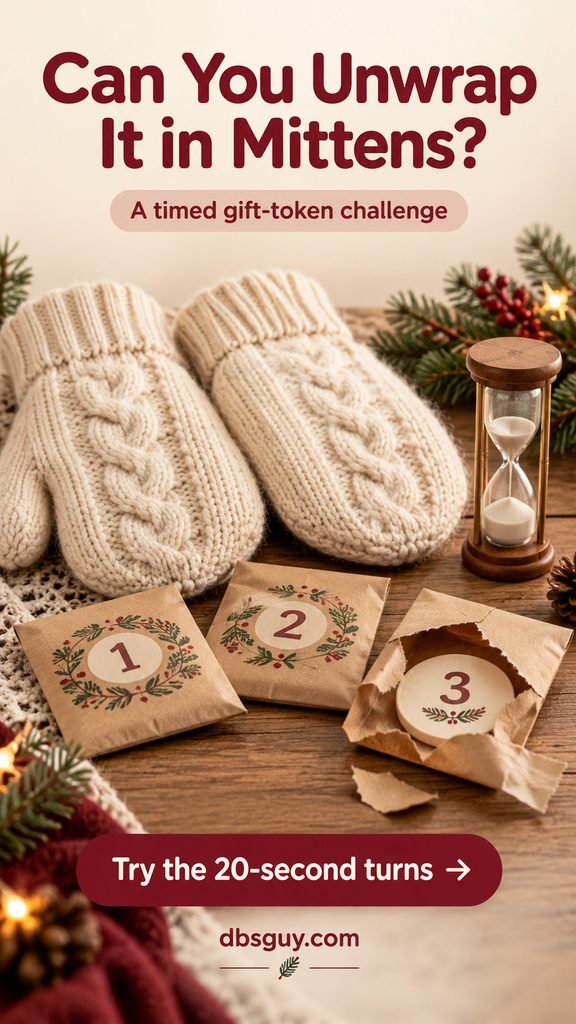
16. Mitten Unwrap Challenge
Best for: 4–10 guests who enjoy a light dexterity game. Allow: 10–20 minutes. Prepare identical token packets, each with two lightly taped paper layers, plus clean oversized mittens and a timer.
Number the main gifts and hide one matching token in each packet. Randomly distribute the packets. One player at a time wears the mittens and gets 20 seconds to work on their own packet; pause it when time ends.
When someone exposes their token, they claim that numbered gift and finish. Continue around the active players for a maximum of three circuits. After circuit three, anyone still wrapping removes the mittens and opens normally.
No teeth, tearing tools, or tightly knotted ribbon. The time limit controls the challenge; it never decides whether someone receives a gift. A helper can unwrap on a player’s behalf.
17. Mystery-Clue Gift Draft
Best for: 4–16 players who like guessing more than stealing. Allow: 10–20 minutes. Ask every giver to attach two honest, nonidentifying clues to their wrapped gift.
A puzzle might say “for a quiet evening” and “best enjoyed at a table.” A travel mug could say “comes along for the commute” and “works with your morning routine.” Avoid clues about supposed value, and do not disguise an unsuitable gift with a misleading description.
Randomly draw the selection order. Read both clues for every gift at the start. On a player’s turn, they choose one remaining package using the clues, then open it. That gift is final; no stealing and no compulsory trade.
The host crosses off each selected number so guests know which mysteries remain. Handmade presents can fit nicely here; browse 30 DIY Christmas Gift Basket Ideas That Are Perfect for Anyone for possible gift-pool themes.

18. Coin-Flip Keep or Trade
Best for: 4–14 players. Allow: 5–15 minutes. You need one coin and randomly distributed wrapped gifts.
Choose a starting player at random and proceed clockwise for exactly one circuit. Each player flips once: heads means keep your current gift for this turn; tails means directly swap with any other player.
All gifts stay wrapped until the last flip. A gift held by someone who already flipped may still be selected for a later trade. Heads does not protect a gift, and tails does not create another turn for the person receiving the roller’s package.
After everyone has flipped once, open and keep what you hold. Call the two outcomes before every flip if younger guests are playing. The appeal is a single simple decision from the coin rather than a six-action dice key.

19. Gift-Number Memory Match
Best for: 4–10 players at a table. Allow: 15–25 minutes. Make two identical cards for every gift number, with matching blank backs.
Number the gifts, shuffle all paired cards, and lay them facedown. Players take turns revealing two cards. A match earns the gift with that number; remove the pair and retire that player from the game. An unsuccessful pair is shown to everyone, then turned facedown again.
Move to the next active player after each turn. Do not give the matching player an extra turn, since they have already received their gift. The last player takes the final pair and gift automatically.
If play reaches 20 minutes, reveal the remaining cards and let unfinished players draw the remaining gift numbers randomly. Everyone gets one gift without a memory contest dragging through dinner.

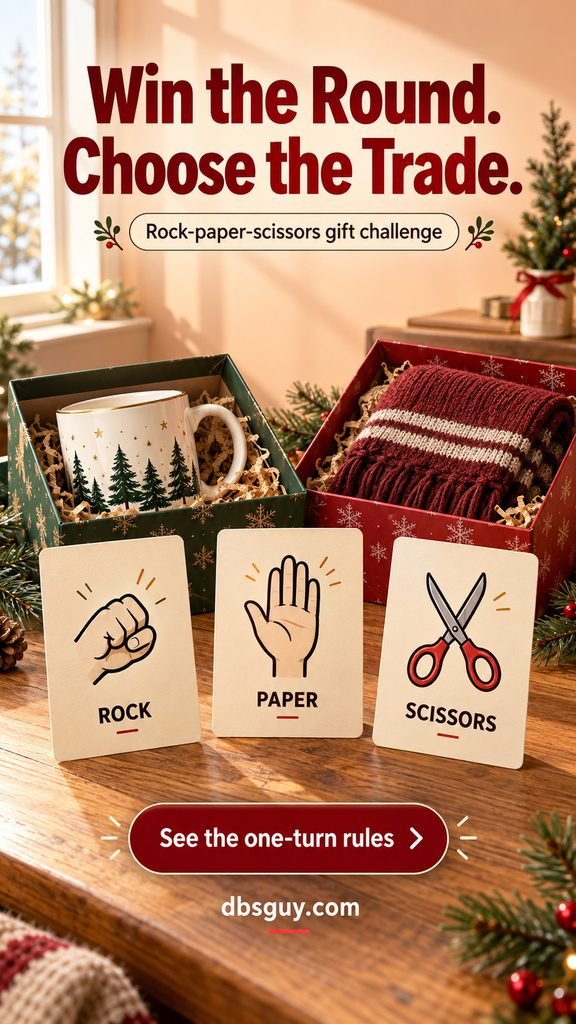
20. Rock-Paper-Scissors Gift Challenge
Best for: 4–14 players who want a little strategy. Allow: 10–15 minutes. Randomly distribute and open all gifts before starting.
Draw a turn order. Each player gets one turn as challenger and chooses any other player. Count “one, two, three,” then reveal together: rock beats scissors, scissors beats paper, and paper beats rock. Ties repeat, up to three attempts. If all three tie, flip a coin to pick the winner.
The winner decides whether those two players exchange gifts or keep what they currently hold. The decision affects only that pair. Both keep one gift either way, and there is no follow-on challenge.
Stop after everyone has had one challenger turn, even if some people were selected as opponents more often. Previously traded gifts remain available. Use illustrated symbol cards if hand gestures are difficult, and announce in advance that challenges are part of this game’s rules.
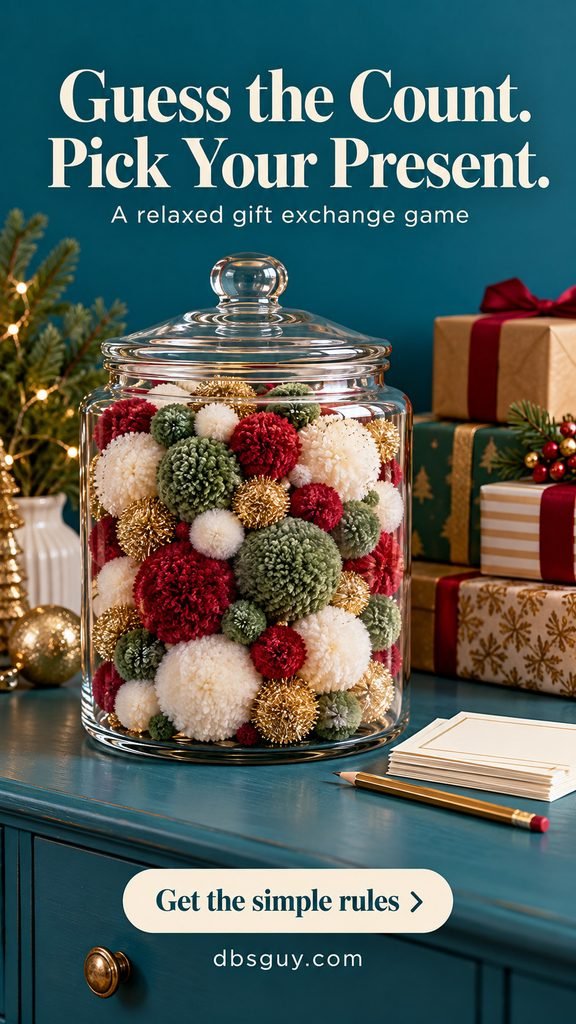
21. Guess-the-Count Gift Draft
Best for: 4–30 guests and a relaxed arrival activity. Allow: 5 minutes for guesses, then 1 minute per gift choice. Fill a clear jar with large craft pom-poms or folded paper stars.
Count the contents before guests arrive and seal the answer in an envelope. Give every person one written guess without opening or handling the jar. Closest guess, above or below, chooses a wrapped gift first; the next closest chooses second, and so on.
If two guesses are equally close, draw numbered slips for their relative order. Someone who arrives after the answer is revealed goes at the end of the selection order. Every participant still chooses one gift.
Reveal the count, rank all guesses, and finish the gift draft without adding a second guessing round. The jar is a game prop rather than an extra prize, unless the host clearly says otherwise before play.
A Short Host Script You Can Read Aloud
“We are playing [game name]. Each player will leave with one gift. Our spending cap is [amount], and our gift theme is [theme]. Here is how a turn works: [explain your chosen game’s action]. We stop after [its exact ending]. Your own gift may come back to you. If you need help reading, passing, or unwrapping, let me know. Please wait until I finish explaining before we start.”
For White Elephant, add the three-steal turn limit, the three-theft gift freeze, and Player 1’s single final swap. For the other games, do not add stealing or extra turns unless the written rules above include them.
Gift Exchange Questions Hosts Often Ask
What is the easiest gift exchange game?
For a last-minute gathering, ribbon pull is particularly simple: choose one ribbon and claim the matching numbered gift. If you want everyone to play together for longer, musical gifts requires only a circle, music, and five announced stops.
What is the difference between Secret Santa and White Elephant?
Secret Santa assigns a particular recipient before shopping. White Elephant uses a common gift pool, with gifts chosen or stolen during the party. A name tag belongs on a Secret Santa gift; a shared-pool White Elephant gift usually stays anonymous.
How many times can you steal a White Elephant gift?
There is no single limit every group uses. In the version above, a gift freezes on its third theft across the game, and each numbered turn allows a maximum of three steals total. State both limits before the first gift opens.
Can these games work with an odd number of people?
Yes. None of the games requires fixed pairs. For the team relay, equalize the total wrapping turns by letting a volunteer on the smaller team go twice. In Secret Santa, check the full assignment list so everyone gives and receives once.
What if someone forgets a gift or arrives late?
A host backup gift can cover someone who forgot. Add late arrivals before a game starts, or save their present for a separate agreed exchange. Do not insert a new player midway through a numbered turn order or a nearly finished passing game.
Which games work for a large office party?
Secret Santa, gift-claim bingo, and guess-the-count draft scale more comfortably than repeated physical passing. For more than about 20 people, consider smaller groups with separate gift pools. Keep the gift budget and participation expectations consistent across them.