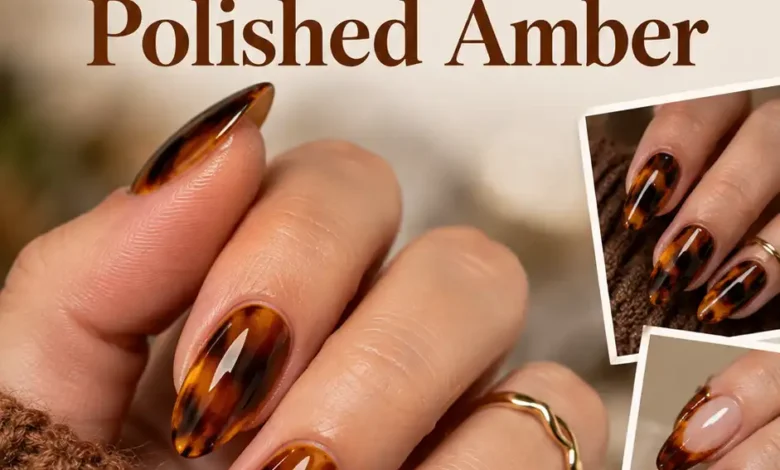
Tortoiseshell nails have the same appeal as a favorite pair of brown acetate sunglasses: warm color, a little depth, and a pattern that makes a simple outfit feel considered. On a November manicure, those amber and espresso patches look especially good next to an oatmeal sweater, a camel coat, or a burgundy sleeve.
The trick is choosing how much print you actually want. These 21 tortoiseshell November nail ideas range from a single accent to full amber sets, with French tips, sheer panels, and small metallic details in between. Every design includes its own image and a salon note, so you can save the placement you love instead of trying to describe it from memory.
Choose the Pattern, Placement, and Finish First
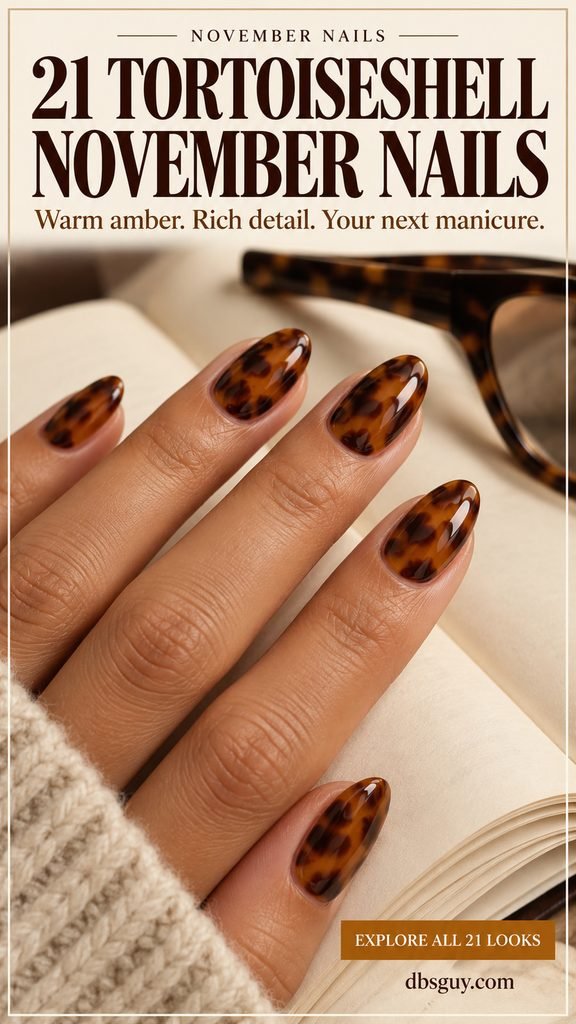
Think of tortoiseshell as uneven patches of color with lighter areas showing between them. The warm classic combines amber, chestnut, and very dark brown. Softer versions leave more honey visible; deeper ones give more space to espresso. The patches do not need to match from nail to nail.
Start with the amount of coverage: one accent, a French tip, or the whole nail. Then choose the scale. A narrow tip needs a smaller pattern, while a full almond nail can show broader patches. Save a close-up that shows both the colors and the spaces between them.
For an everyday starting point, look at the short amber set or the single accent. If you want a November dinner manicure, the fine gold line and scattered foil add detail without requiring an entirely different palette.
In Who What Wear’s short fall-nail guide, nail educator Vikki Swan recommends keeping tortoiseshell translucent and avoiding too much detail on short nails. The smaller designs below take that approach.
1. Classic Amber Tortoiseshell on Short Oval Nails
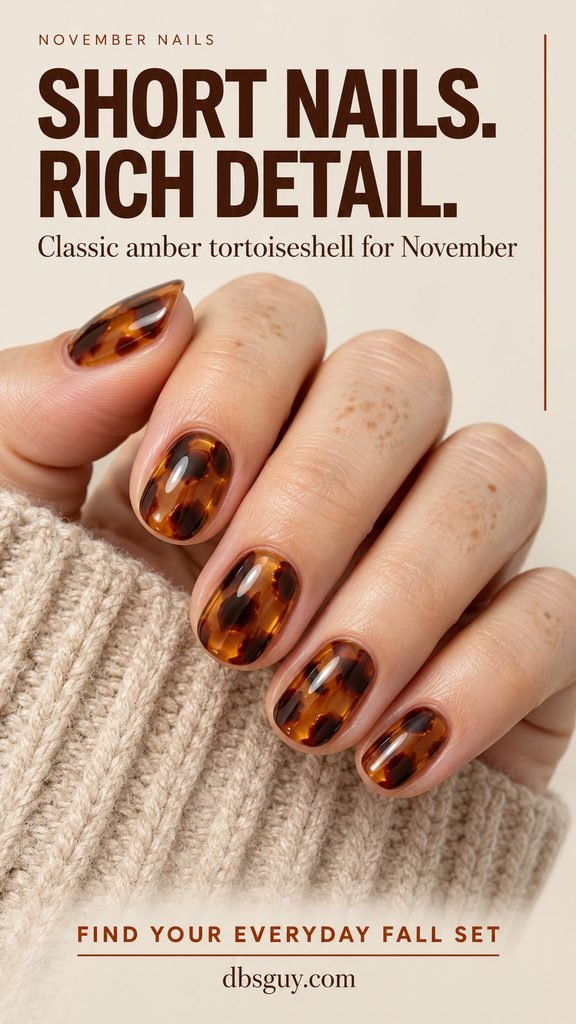
Short oval nails give classic tortoiseshell a compact, easy-to-wear shape. The bright amber spaces are just as important as the brown patches: they keep the pattern visible when you glance down at your hand. An oatmeal sleeve brings out the warmth without adding another strong color.
Choose this version if you want the print itself to do the work. Skip extra stripes or jewelry on the nails, and ask the artist to vary the patch shapes slightly. The result should feel like a coordinated set, with each nail showing a different part of the same pattern.
Salon note: Short oval nails with full amber tortoiseshell, irregular dark-brown patches, visible lighter spaces, and a glossy finish. No extra accents.
2. Soft Caramel Tortoiseshell on Almond Nails
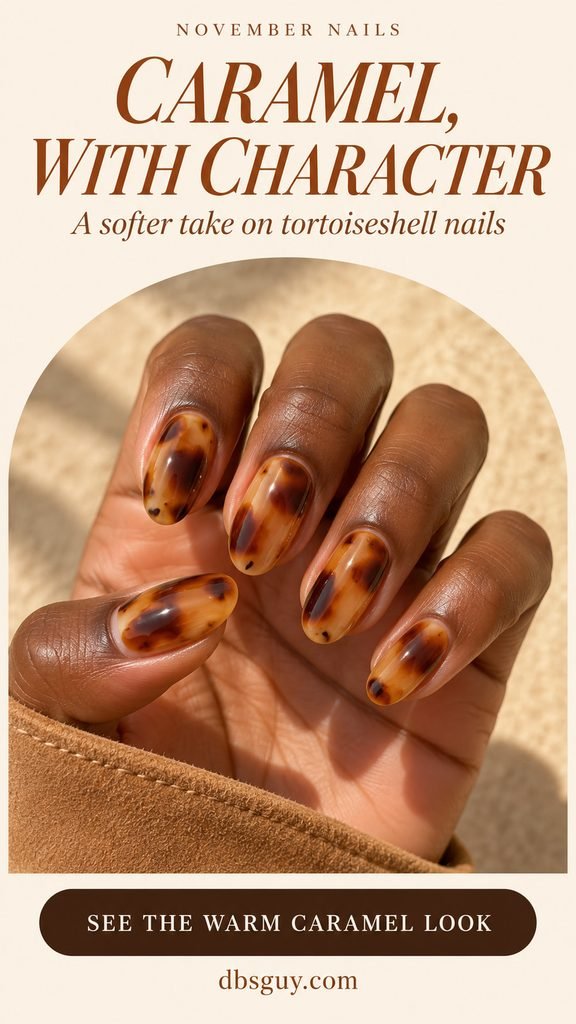
This caramel version feels softer because the lighter color takes up more of the nail. Broad chestnut patches drift across the base, with just a few deeper marks for contrast. The rounded almond outline gives the print room to spread rather than packing it into tiny details.
Look at the balance of light and dark before the whole set is painted. If you love the honeyed appearance in the image, ask to keep caramel dominant. A few dark patches will still define the pattern; covering every gap would turn it into a much moodier manicure.
Salon note: Medium rounded almond nails with a caramel-dominant base, broad soft chestnut patches, and very little near-black detail. Finish glossy.
3. Dark Espresso Tortoiseshell on Short Square Nails
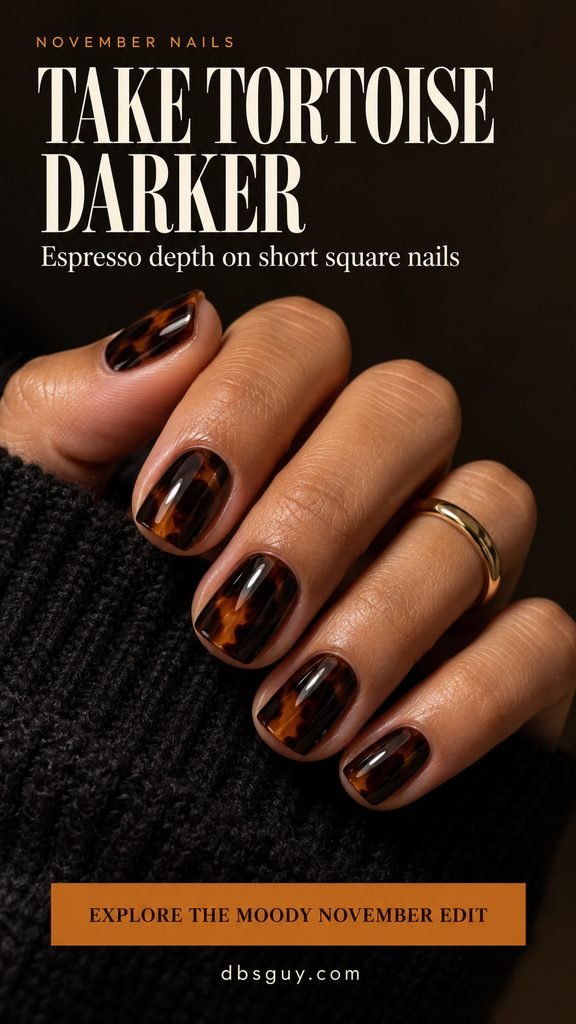
For a darker November look, let espresso become the main color and leave small amber openings inside the pattern. The short square shape gives the set a neat outline, while the warm flashes stop it from reading as plain black polish.
A close-up can make this design appear brighter than it does across a room. Ask to check a sample in ordinary indoor light if visible pattern matters to you. A little more amber around the middle of each nail can help the tortoiseshell detail remain noticeable.
Salon note: Short soft-square nails with dark espresso tortoiseshell and small, clearly visible amber openings. Keep the surface glossy and the pattern readable.
4. Blonde Honey Tortoiseshell With Soft Cocoa Patches
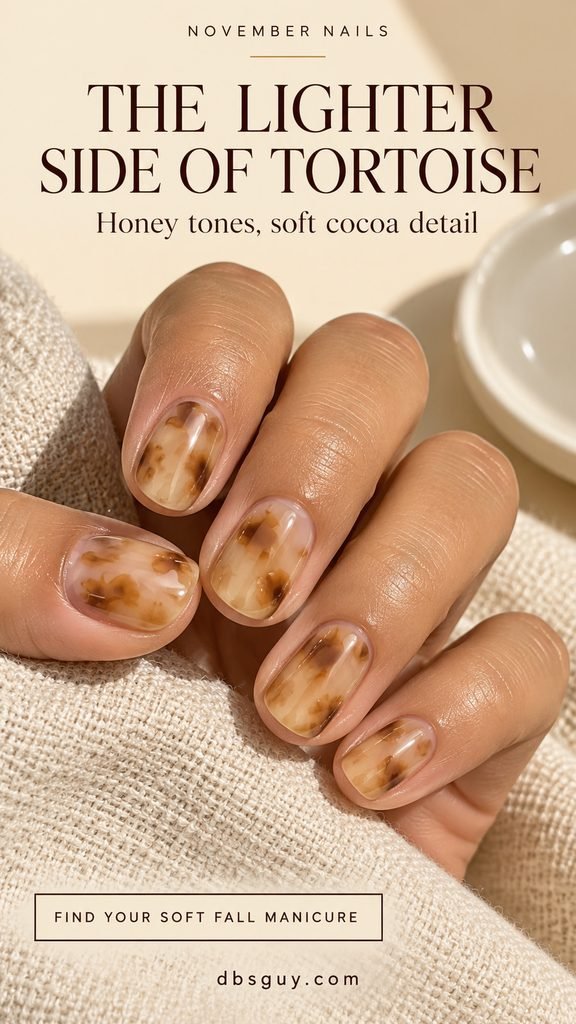
Blonde tortoiseshell offers a lighter option for anyone who likes beige nails but wants a little pattern. Here, a pale honey base carries soft cocoa marks rather than heavy black patches. The colors sit close together, giving the manicure a quiet, warm look.
Choose a base you enjoy on its own because plenty of it will remain visible. Then keep the darker marks sparse and uneven. Cream linen, a pale sweater, and simple gold jewelry fit this softer version without making the nails disappear into an all-brown outfit.
Salon note: Short squoval nails with a pale honey-beige base and sparse, softly edged cocoa patches. Low contrast, no heavy black areas, and a glossy finish.
5. Slim Tortoiseshell French Tips on Short Nails
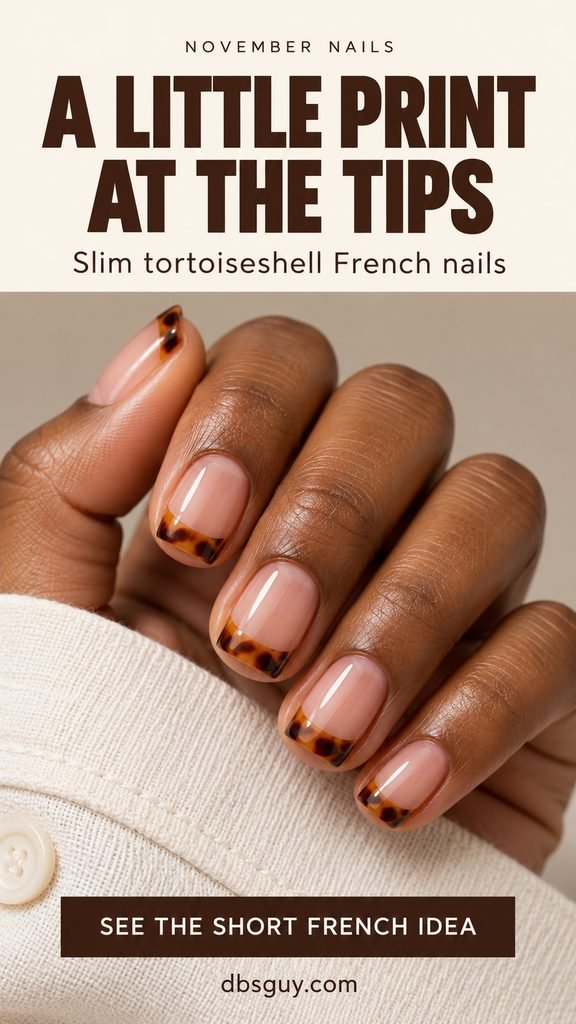
A slim French tip gives you a small dose of tortoiseshell while leaving most of the nail sheer. The peach-pink base keeps the look light, and the amber edge adds enough warmth to make it feel at home in November.
The tip still needs enough width for the mottling to show. If it becomes a hairline, the different colors may read as one brown stripe. Ask your artist to scale the patches down and leave a few tiny amber gaps along the curve.
Salon note: Short squoval nails, sheer peach-pink beds, and narrow tortoiseshell French tips. Keep the pattern small but visible within each curved tip.
6. Deep Tortoiseshell French Tips on Coffin Nails
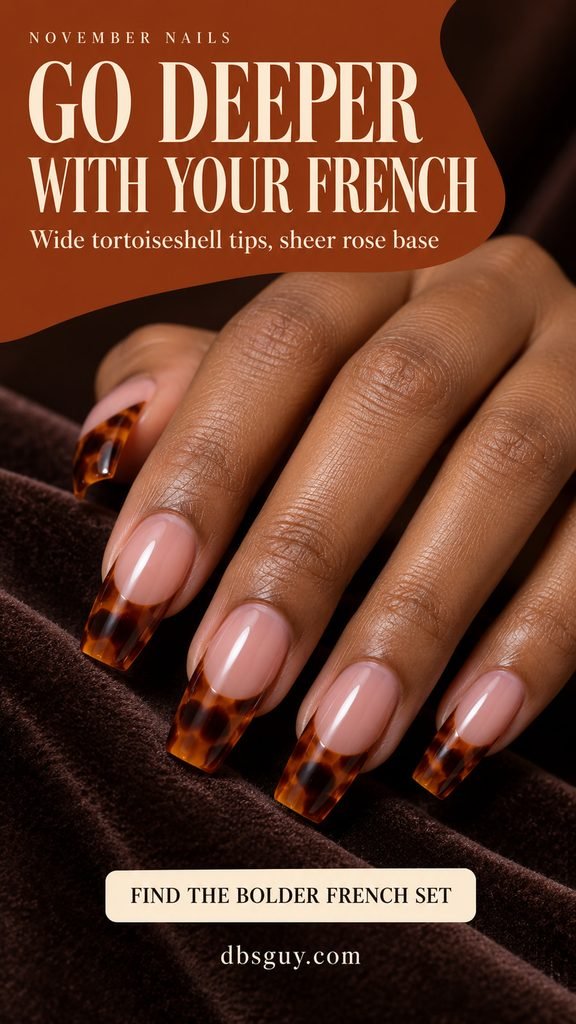
A deeper French tip makes the print a bigger part of the manicure. On a coffin shape, the wide amber ends have space for larger brown patches, while the sheer rose beds create a clear break between skin and pattern.
Decide how far the tip should extend down the nail before painting begins. This reference uses roughly the outer third to half, with curved smile lines rather than a straight horizontal division. A medium length is enough to show that proportion; you do not need an extreme extension.
Salon note: Medium-long coffin nails with sheer rose beds and deep tortoiseshell French tips covering about the outer third to half. Keep the smile lines curved and the finish glossy.
7. Side-Swept Tortoiseshell French Nails
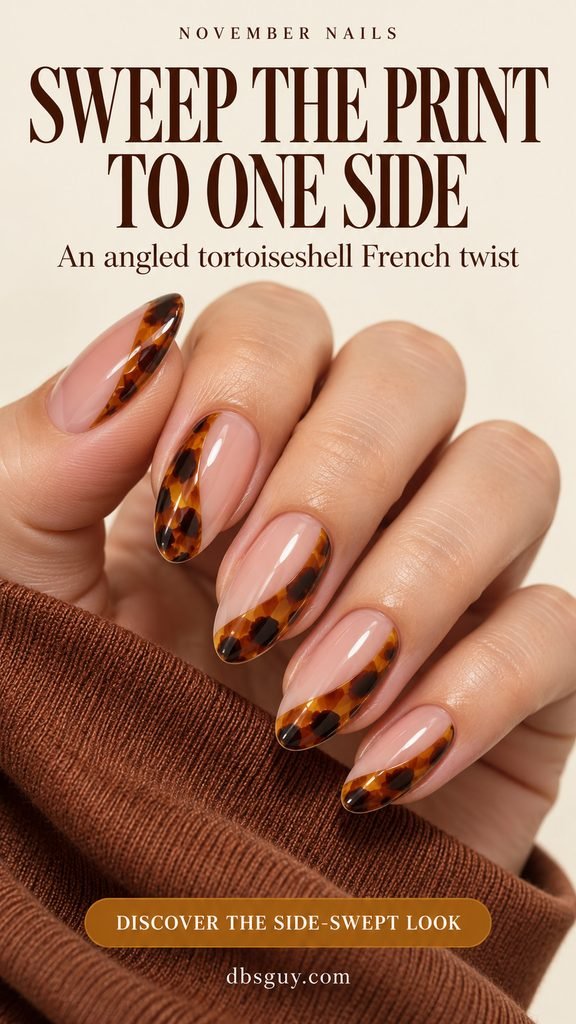
Sweeping the print along one side changes the entire outline of a French manicure. Instead of sitting evenly across the end, the tortoiseshell curves around a sidewall and into part of the tip. The open nude area makes the diagonal movement easy to see.
Decide how far you want the print to travel up the side. The curve can vary across the hand, with a little more pattern on one edge and more open space on another. A warm nude base keeps attention on the amber band, while a cinnamon sleeve picks up the color without repeating the print.
Salon note: Sheer nude almond nails with tortoiseshell sweeping along one side and into part of each free tip. Leave most of each nail bed clear.
8. One Tortoiseshell Accent With Milky Pink Nails
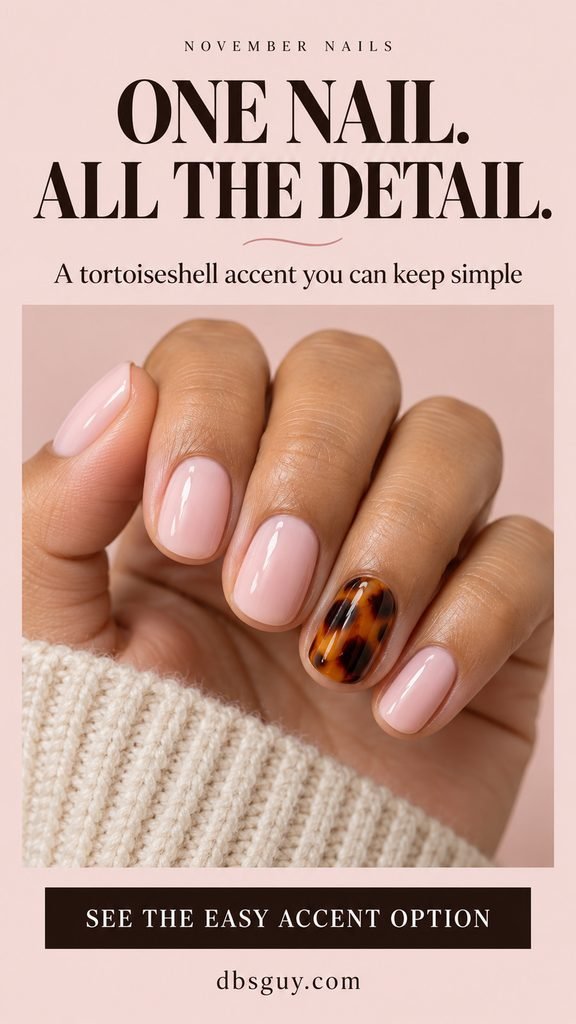
One patterned ring finger is a gentle introduction to tortoiseshell. The other nails stay milky pink, so the amber accent becomes the focus without filling the entire hand with print. Short rounded shapes keep the whole set simple.
This is also a useful way to decide whether you enjoy the color contrast before choosing a full set next time. Pick the pink base first, then compare it beside an amber sample. A warm pink usually gives this particular combination a softer transition than a stark white base.
Salon note: Four glossy milky-pink nails and one full tortoiseshell ring-finger accent. Keep all nails short and rounded, with the same smooth finish.
9. Burgundy Nails With Two Amber Tortoiseshell Accents
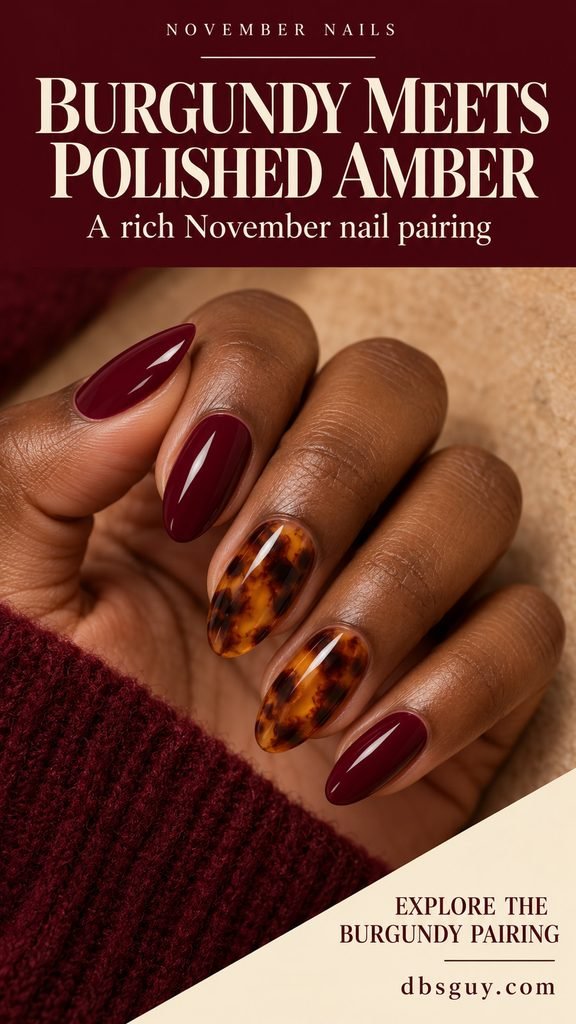
Deep burgundy gives amber tortoiseshell a richer backdrop. Two patterned nails sit together in the middle of the hand, framed by solid wine color on the thumb, index, and pinky. It is a strong November combination for dinner plans or a dressed-up weekend.
Keep the burgundy solid so the contrast comes from pattern rather than several competing effects. When choosing the red, compare it directly with the darkest brown in the tortoiseshell. A deep wine shade links the two without needing matching patches on every finger.
Salon note: Burgundy on the thumb, index, and pinky; full amber tortoiseshell on the middle and ring fingers. Medium almond shape and gloss throughout.
10. A Vertical Split of Ivory and Tortoiseshell
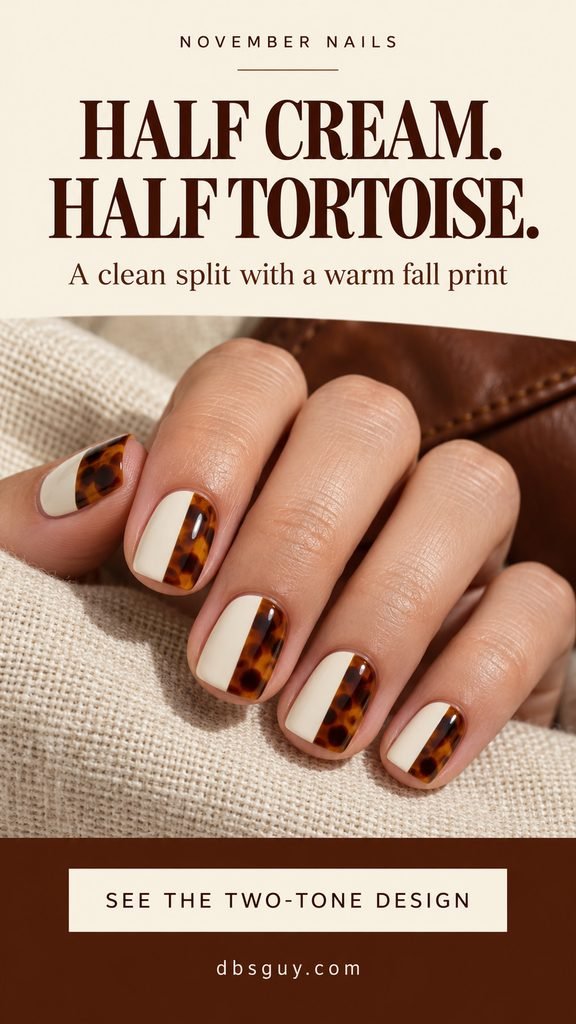
Half ivory and half tortoiseshell creates a clear graphic contrast. The straight vertical seam gives the irregular print a tidy boundary, while the creamy side provides a place for the eye to rest. On short square nails, the division feels especially deliberate.
Choose warm ivory rather than a bright blue-white if you want the softer effect shown here. Keep the dividing line clean and let the tortoiseshell patches vary within their half. There is already plenty of detail, so this version does not need a metallic border.
Salon note: Short square nails divided vertically into equal warm-ivory and amber-tortoiseshell halves. Straight central seams, no extra outlines, and a glossy finish.
11. Slim Tortoiseshell Panels on a Sheer Base
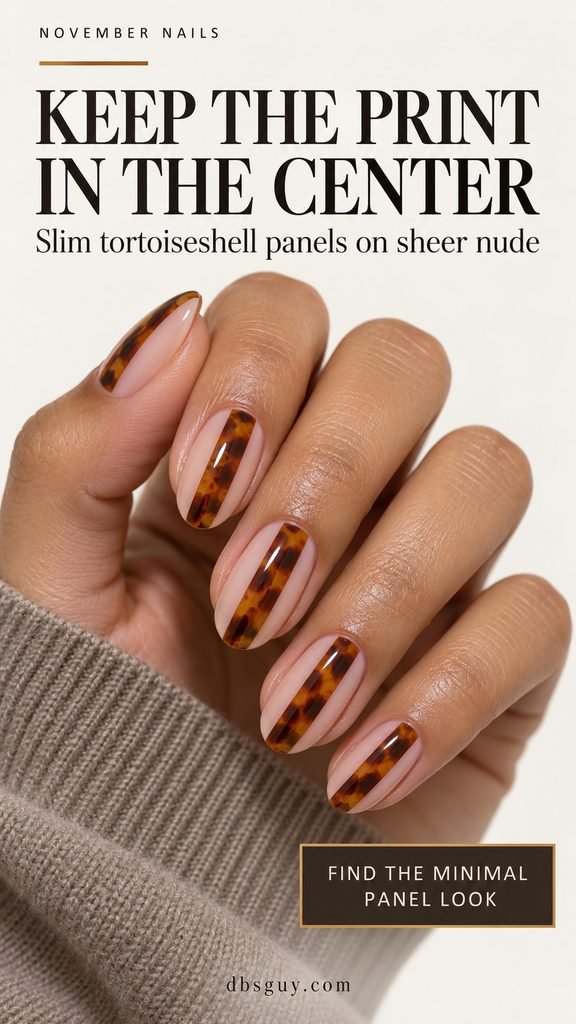
A narrow center panel turns tortoiseshell into a small, controlled detail. Sheer nude remains visible along both sides, while the amber strip draws the eye down the nail. The design gives you more print than a thin French tip without covering the whole surface.
Keep the panel edges straight and the width consistent relative to each nail. Around a third of the nail’s width is a useful visual starting point, then your artist can adjust it. Choose small patches inside the strip so the pattern still looks varied.
Salon note: Sheer nude oval nails with one straight, narrow tortoiseshell panel down the center. Leave balanced nude margins on both sides and finish glossy.
12. Tortoiseshell Half-Moons Near the Cuticles
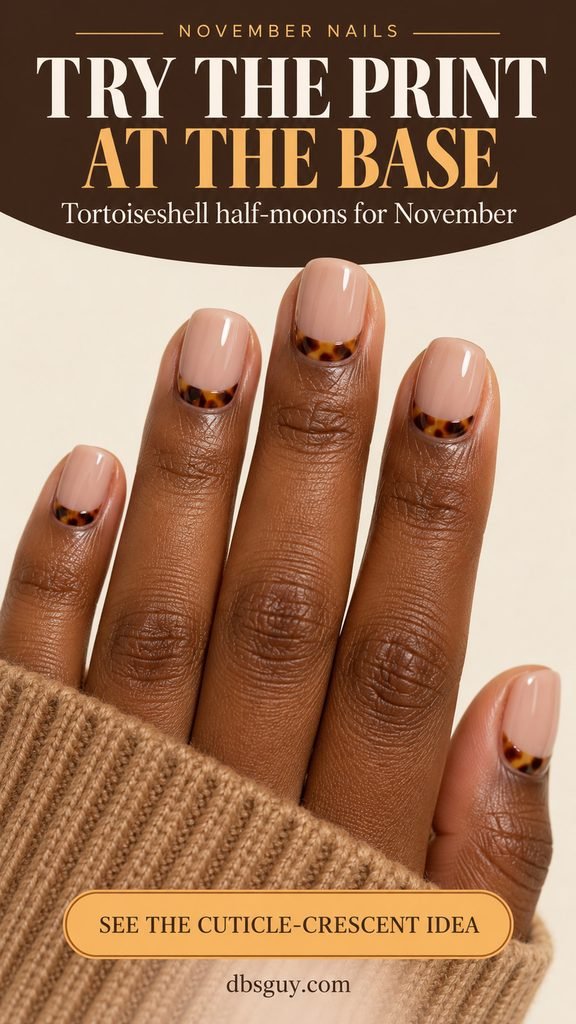
Moving the print to the base of the nail gives a familiar manicure detail a different position. Small tortoiseshell half-moons sit near the cuticles, while the rest of each nail stays sheer. The effect is compact enough for short squoval nails.
Point to the cuticle area when showing the reference, because a request for a patterned crescent can be interpreted as a French tip. Keep the half-moons shallow and the upper nail beds open. Their curved edges should follow the natural base shape without touching the skin.
Salon note: Small amber tortoiseshell half-moons at the cuticle roots only. Leave the upper nail beds and free tips sheer nude; keep the nails short and squoval.
13. Sheer Nude Nails Framed in Tortoiseshell
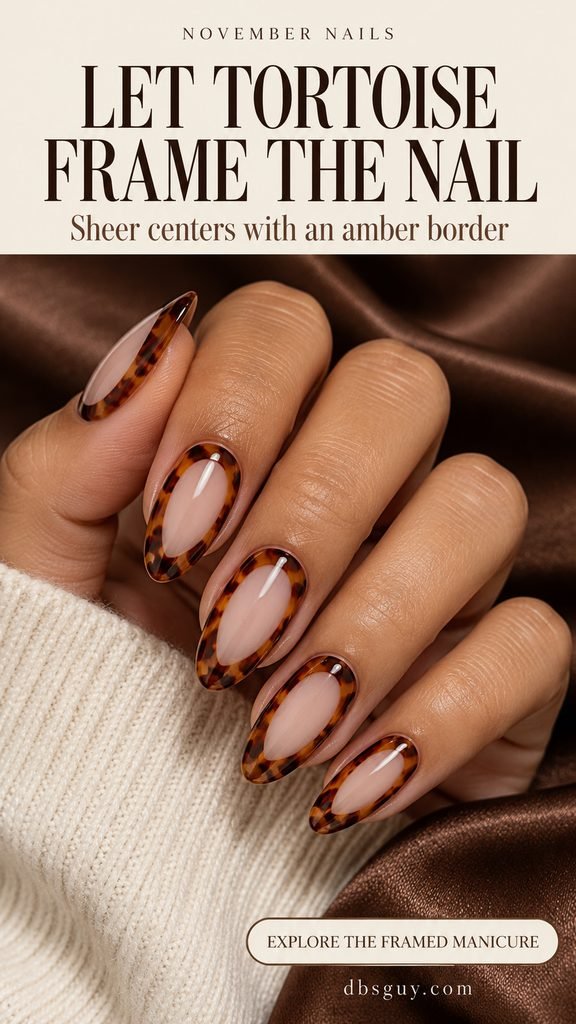
A tortoiseshell border frames a sheer center like a tiny piece of brown acetate. Because the print travels around the whole nail, the shape becomes part of the design. Almond nails suit the curved window especially well.
The border needs enough width to show more than a single dark line. Ask the artist to map out one nail first, balancing the center window with the patterned edge. If your nails are narrow, a slightly wider frame on one accent nail may communicate the idea more clearly than very thin borders everywhere.
Salon note: Sheer nude center windows surrounded on every side by amber tortoiseshell borders. Keep the windows clean, the frames visibly patterned, and the finish glossy.
14. Tortoiseshell French Tips With Fine Gold Smile Lines
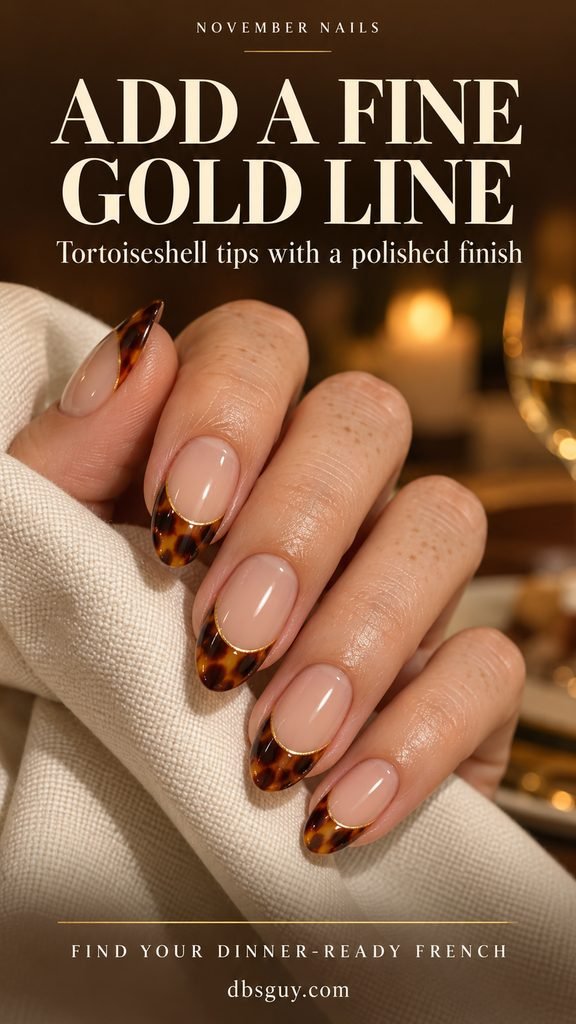
A fine gold line under the French tip gives tortoiseshell a dressed-up edge. The metal follows the smile line, separating the sheer beige bed from the amber print. It is a small detail that works beautifully beside a simple ring or a warm metallic clutch.
Keep the line delicate enough that the tortoiseshell remains the main feature. A broad gold band would create a different, heavier look. For a Thanksgiving dinner manicure, this is an easy reference to save when you want seasonal color with a little evening polish.
Salon note: Sheer beige oval nails with tortoiseshell French tips and one fine metallic gold line along each smile-line boundary. No additional metallic details.
15. Full Tortoiseshell Nails With a Thin Black Edge
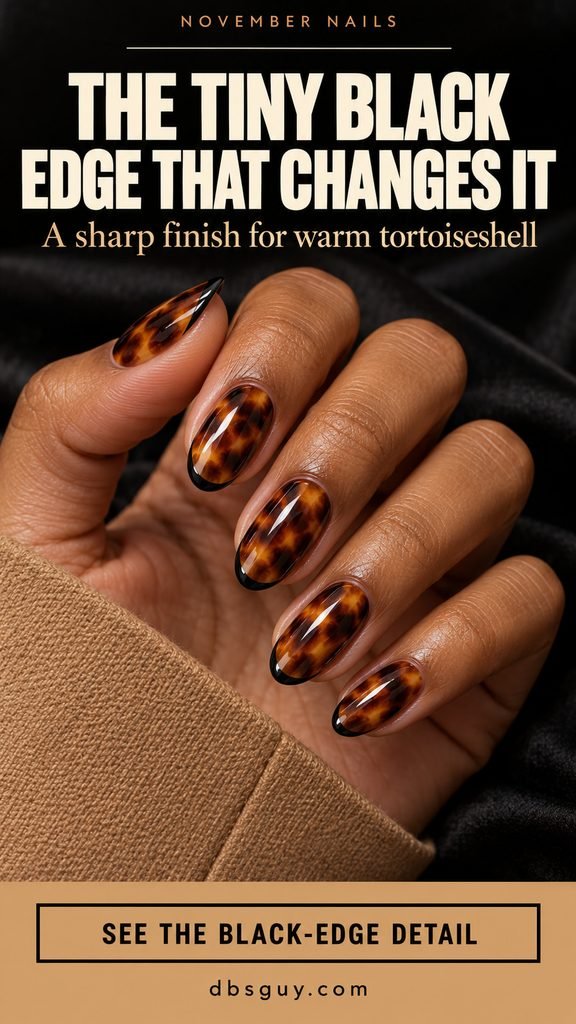
A tiny black edge gives full tortoiseshell nails a sharper outline. Most of the surface remains warm amber and brown; the thin tip adds a crisp finish that stands apart from the softer patches beneath it. It is a good match for a black sweater and a camel jacket.
Be specific that you want black at the free edge only. If the line grows too deep, it will cover much of the pattern and become a stronger French design. The narrow edge is what makes this version feel precise.
Salon note: Full glossy amber tortoiseshell on oval nails, with an ultra-thin solid-black line along each free tip. Keep almost all of the pattern visible.
16. Matte Tortoiseshell With Glossy Tips
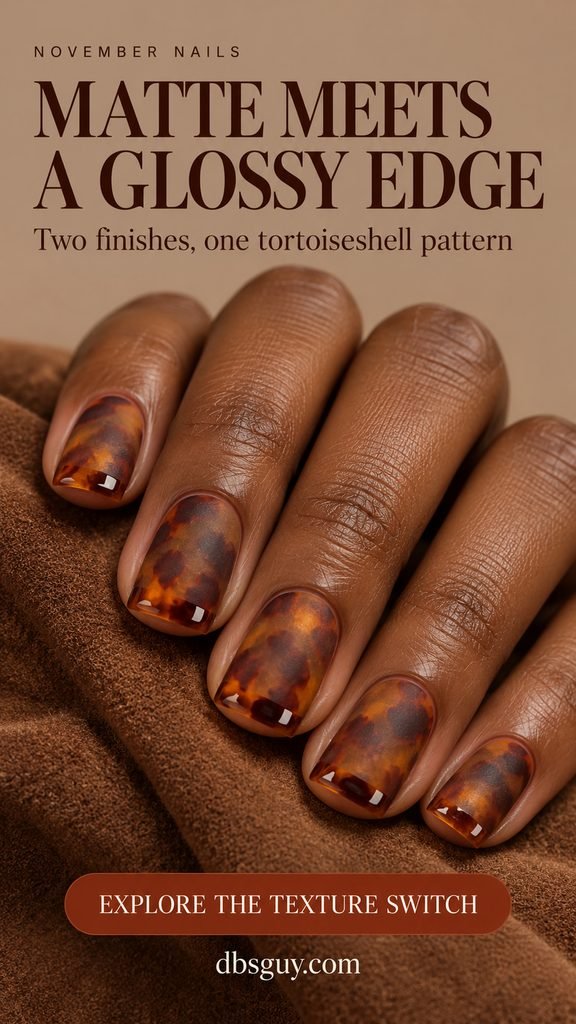
Using two finishes changes the look without adding another color. The main tortoiseshell surface stays matte, while a narrow glossy tip catches the light. The same amber pattern continues underneath both finishes, which makes the contrast feel subtle.
This detail is easiest to judge when the hand moves. Ask to see the sample tilted under a light so you can check the change in sheen. A clear glossy edge is the request here; a black or cream French tip would hide the texture idea.
Salon note: Full tortoiseshell on short soft-square nails, matte across the main surface with clear glossy French-shaped tips over the same pattern. No added tip color.
17. Deep Teal Curves Over Amber Tortoiseshell
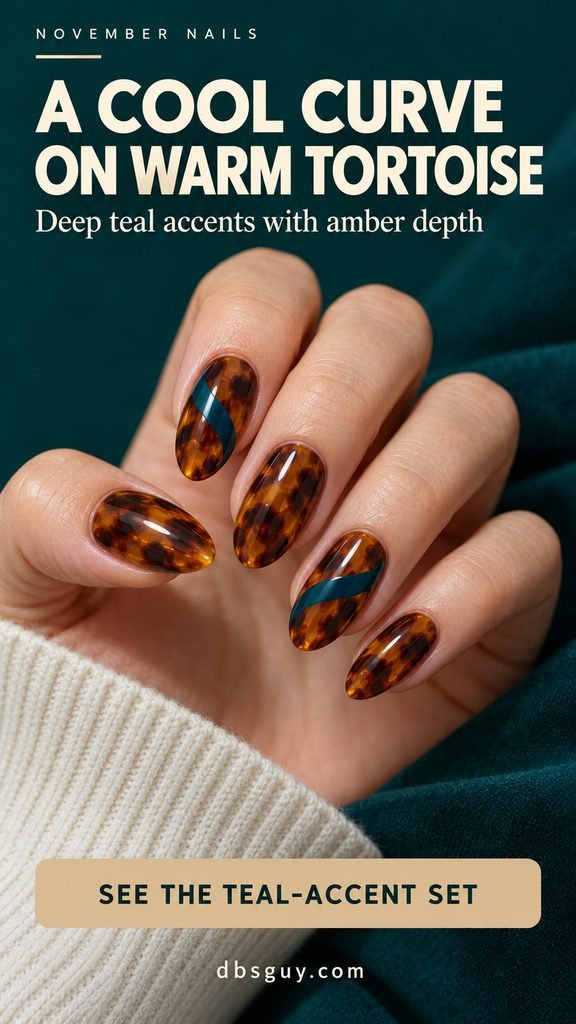
Deep teal gives warm tortoiseshell a cooler accent. One curved band crosses the index and ring nails, leaving the print visible on both sides. The other nails remain plain tortoiseshell so the two colored sweeps have room to stand out.
Choose a deep, muted teal if you want this November palette to stay moody. The band should be wide enough to read as a deliberate curve but narrow enough to preserve the amber underneath. Repeating teal in a scarf or sweater is plenty of coordination.
Salon note: Full amber tortoiseshell with one deep-teal curved band on the index and ring nails only. Keep the other nails plain tortoiseshell and all surfaces glossy.
18. Dark Tortoiseshell With Two Tiny Silver Studs
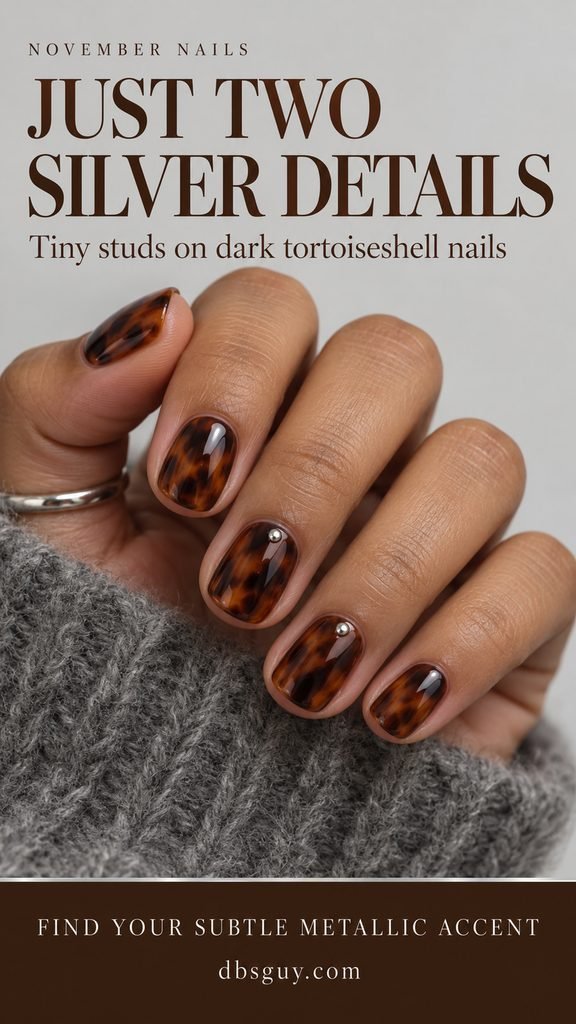
Two tiny silver studs create a cool contrast against dark amber and espresso. Placed near the cuticles on the middle and ring fingers, they catch a little light without covering the pattern. The short rounded shape keeps the set understated.
Ask for low, small accents if you prefer less texture on your nails. The studs should be visible as points of silver, not large pieces of hardware. A gray wool sleeve and a simple silver ring bring out that cooler detail in the otherwise warm manicure.
Salon note: Short rounded dark tortoiseshell nails with one tiny silver stud near the cuticle on the middle and ring fingers. Two studs total; glossy finish.
19. One Tortoiseshell Heart on Dusty Rose
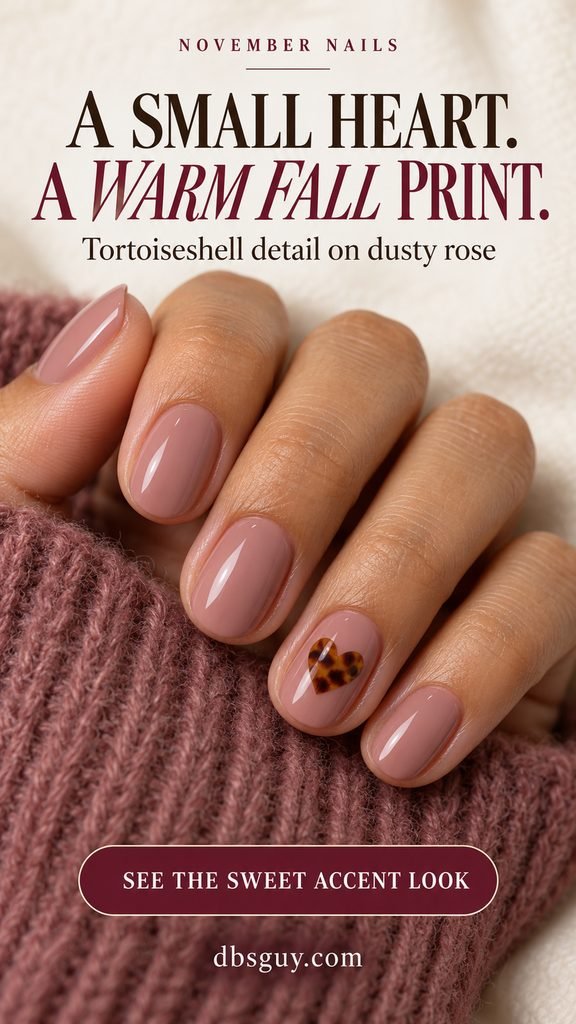
A small tortoiseshell heart gives a dusty-rose manicure one playful detail. Keeping it on the ring finger leaves the rest of the set calm, and the warm amber filling sits comfortably beside the muted pink. The heart belongs in the middle of the nail, rather than forming its tip.
Leave enough pink around the shape to make the outline easy to read. Inside the heart, a few tiny brown patches are enough to suggest tortoiseshell. Too much dark color can turn it into a solid brown heart and lose the reason you chose the design.
Salon note: Short dusty-rose oval nails with one small tortoiseshell-filled heart centered on the ring finger. Keep the other nails solid and leave pink around the heart.
20. Amber Tortoiseshell With Scattered Gold Foil
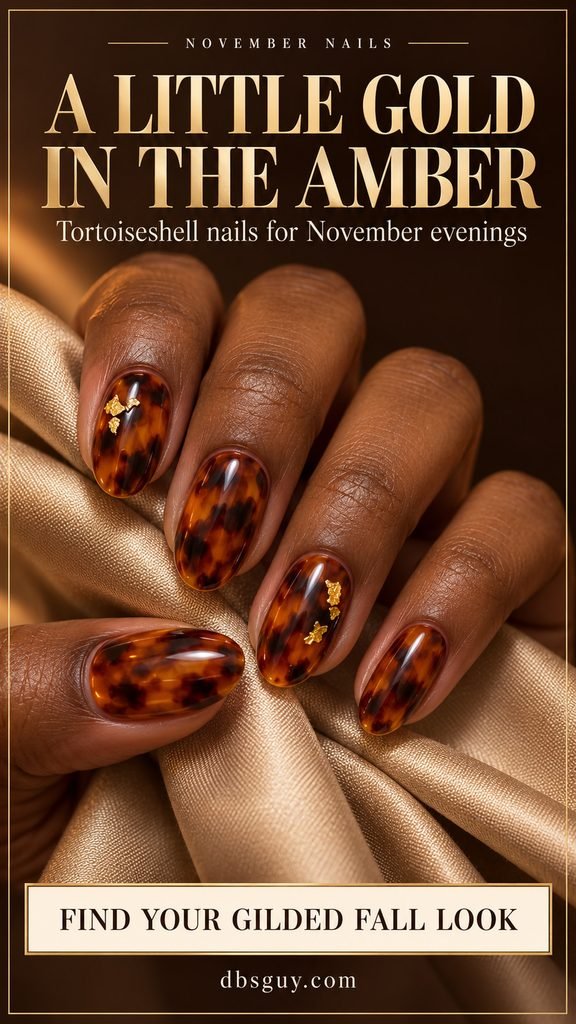
Small gold flakes give amber tortoiseshell a little extra light for November evenings. They sit over just two nails, leaving the rest of the set focused on the print. The irregular foil shapes echo the uneven patches without repeating them exactly.
Keep the foil sparse so it reads as a finishing detail. A few tiny pieces on the index and ring fingers are enough for this reference. Ask for a smooth sealed surface if you want the appearance of gold leaf without a deliberately raised texture.
Salon note: Glossy amber tortoiseshell with a few tiny flat gold-foil flakes on the index and ring nails only. Leave the remaining nails unembellished.
21. Curved Tortoiseshell Ribbons on Sheer Nude Nails
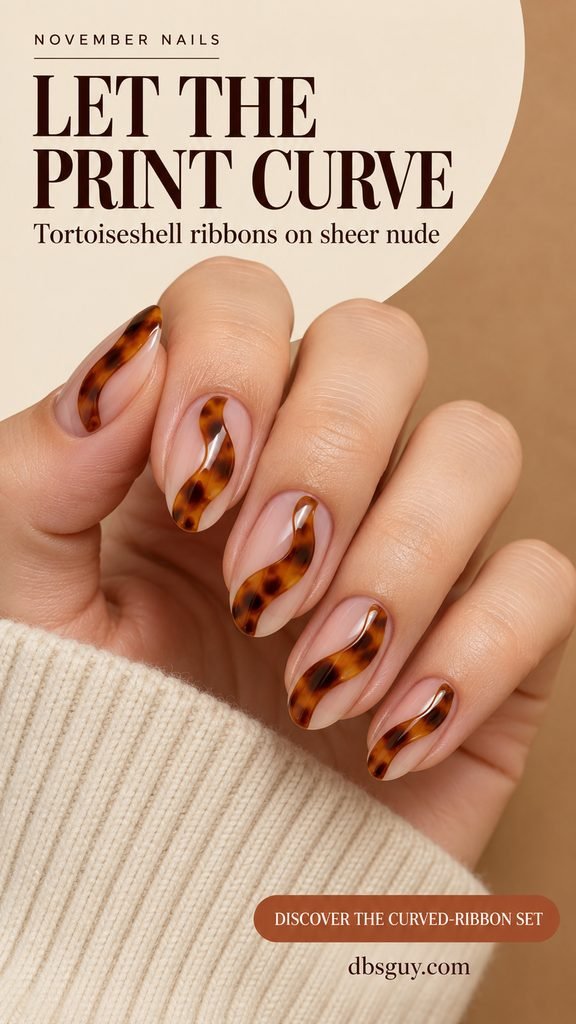
A curved ribbon lets tortoiseshell travel across the nail while leaving sheer space around it. Each band follows a gentle S shape, with the print contained inside the curve. It is a softer, more fluid alternative to the straight center panels.
The ribbon needs enough width for its amber and brown patches to show. Ask for one clear sweep on each nail instead of several thin squiggles. The exact bend can change with the nail shape; keeping the width and colors consistent connects the whole set.
Salon note: One broad S-shaped tortoiseshell ribbon on each sheer nude rounded almond nail. Leave clear space on both sides and keep the print visible inside each curved band.
What to Tell Your Nail Artist
Bring the image that shows your preferred placement, then point out the lightest and darkest areas. Tell your artist whether you want amber to dominate or a deeper espresso result. The words “tortoiseshell nails” alone leave a lot of room for interpretation.
Confirm the shape, length, accent fingers, and finish before the service starts. Ask for a sample if you are choosing between two base shades or between matte and gloss. Mention detailed frames, metallic lines, foil, or studs when booking so the salon can allow for the extra work and confirm its price.
How to Try a Simple Tortoiseshell Accent at Home
Start with one accent nail and regular air-dry polish. Choose compatible base and top coats, a sheer amber shade, and a darker brown. A practice tip helps you see how transparent the colors are before committing to a full manicure.
Build an uneven pattern rather than matching dots: leave amber showing, add a few irregular darker patches, and overlap only some of them. Let layers dry as directed. A thin sheer veil can soften the contrast, but stop before it hides the pattern.
Finish with a compatible top coat once the design is ready according to the product instructions. For exact product combinations, use a brand’s complete tutorial. Gel products require their own application and curing directions.
For lacquer methods, see OPI’s Outta Your Shell tutorial and Cirque Colors’ tortoiseshell instructions. Both illustrate ways to build uneven, layered color; follow the directions for the specific products you use.
Tortoiseshell November Nails: FAQs
Can tortoiseshell nails work on short natural nails?
Yes. A compact oval or squoval shape can carry the full print, one accent, or a small French tip. Keep the pattern readable by leaving lighter gaps. For very short nails, a full accent may show the detail more clearly than a tiny tip.
Do tortoiseshell nails need gel polish?
No. The OPI and Cirque Colors tutorials linked above both demonstrate lacquer approaches. A salon may use gel or another system for your chosen finish. Pick the design first, then confirm which method your artist offers.
What is the difference between tortoiseshell and leopard nails?
Tortoiseshell usually looks like uneven patches with color showing through and around them. Leopard designs use more recognizable spots or broken ring shapes. For the amber effect here, show a close-up and request irregular mottling rather than repeated outlined spots.
Why does my tortoiseshell pattern look like solid brown?
The dark patches may cover too much of the base, or repeated layers may have reduced the visible contrast. On your next practice tip, leave larger amber areas and check the result before adding another layer. The reference image is useful for comparing the balance of light and dark.
Which tortoiseshell design is the simplest place to start?
The single ring-finger accent is a useful first choice because you only need to plan the pattern on one nail. Straight panels, framed centers, and fine metallic lines require additional precision. If you are doing your own nails, practice the full accent before adding those boundaries.
Save Your Favorite Amber Detail
Save the version that suits how much print you want to see: one warm accent, a small French edge, or a full amber set. Then bring its salon note along with the image. The pattern size, lighter gaps, and placement are the details that will make your November tortoiseshell manicure feel like the one you had in mind.
Manicure images are AI-generated concepts created for dbsguy.com. Your nail artist can adapt the colors, proportions, and placement to your nails.